Different Ways to Start a Speech
When it comes to inspiring, persuading, and influencing audiences, your speech’s most essential element is the opening.
So how do you start your speech in a way that will get the audience on your side?
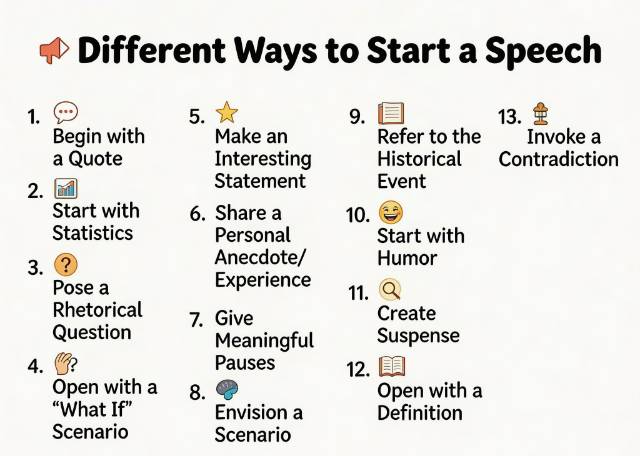
Here are 13 effective ways to start your speech successfully every time.
Begin with a Quote
Quotes are gems of wisdom that resonate with people. They inspire and motivate while being easy to remember.
Well-thought-out words of history’s best orators can sometimes be the ticket for your successful speech.
One good example is:
| “If your actions inspire others to dream more, learn more, do more, and become more, you are a leader.” – John Quincy Adams. |
Start with Statistics
Statistics are the proof that can add weight to your words.
By opening with compelling and personalized statistics, you can add a quantifiable and persuasive aspect to your message. It provides you the basis for building your argument, supporting your claim, and proving it right.
An example could be:
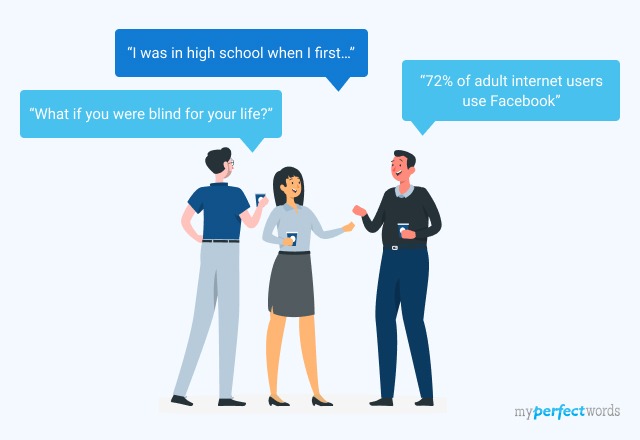
| “72% of adult internet users use Facebook”. |
Pose a Rhetorical Question
Rhetorical questions are engaging and thought-provoking. They invite your audience to think and participate in your presentation. These questions can captivate your listeners and lead them down the path of your message.
A very famous rhetorical question of all times by William Shakespeare is:
| “If you prick us, do we not bleed? If you tickle us, do we not laugh? If you poison us, do we not die? And if you wrong us, shall we not get revenge?” - The Merchant of Venice. |
Open with a 'What If' Scenario
Creating a "what if" scenario sparks curiosity and imagination. You can use this technique to encourage your audience to envision a different perspective or a unique situation related to your topic.
For example:
| “What if you were blind for your life and today you just got to see the world? How have you imagined the world so far? And how do these colors attract you? By the way, is there anyone who is color blind?” |
Make an Interesting Statement
You can start your speech with a powerful and catchy statement without asking the audience to pay attention to you. Interesting statements are very useful in engaging the audience and persuading them to listen and agree with you.
A famous statement from Amy Cuddy’s Ted talk “Your Body May Shape Who You Are” is:
| "So I want to start by offering you a free, no-tech life hack, and all it requires of you is this: that you change your posture for two minutes." |
Share a Personal Anecdote or Experience
Sharing personal experiences creates a genuine connection with your audience. It allows them to relate to you on a human level and sets the stage for a compelling narrative.
For example:
| “I was in high school when I first fell in love…..” |
People love stories of any kind from infancy and childhood. As soon as people learn that you are going to tell a story, they immediately settle down, become quiet and lean forward like kids around a campfire.
Give Meaningful Pauses
Pauses are the unsung heroes of a speech. Well-timed silence can emphasize your message and create an impact that words alone cannot.
Take a little pause every time you need to emphasize something. Knowing where to take a pause helps you make your message effective.
For example:
“Lyla is dead.” Pause “But they don’t know it yet.” |
Envision a Scenario
By using the word "imagine," you can transport your listeners into your narrative. According to Frank Luntz, “One word automatically triggers the process of visualization by its mere mention: imagine.”
“Imagine” scenarios put the audience directly into the presentation by allowing them to visualize the extraordinary scenes.
For example:
| “Imagine you are hiking on Mount Everest, and you are just about to reach the peak, but suddenly you slip and roll down to the ground. How would you feel at that moment?” |
Refer to the Historical Event
You can capture your audience’s attention by referring to a historical event related to your speech. Well-known historical events are good reference points to get the audience to use their imagination.
For example:
| “During the 1960s and ’70s, the United States intervened in the civil strife between North and South Vietnam. The result was a long running war of attrition in which many American lives were lost, and the country of Vietnam suffered tremendous damage and destruction.” |
Start with Humor
Humor, when used thoughtfully, can instantly connect with your audience. It lightens the mood and draws people in, but it's essential to tread carefully to avoid offense.
An example of a humorous beginning is:
| “Speak when you are angry – and you’ll make the best speech you’ll ever regret.” - Dr. Laurence J Peter. |
Usage of humor is a genius trick to get your audience involved in your speech.
Create Suspense
Starting your speech with suspense can immediately capture your audience's curiosity and keep them engaged as they eagerly anticipate what comes next. This technique is effective for drawing your audience into a story, a mystery, or a problem that needs solving.
Example:
| "As the clock struck midnight, and the footsteps echoed in the darkness, she knew that her life was about to change forever. But, what was waiting for her beyond that door?" |
Custom Speeches for Any Occasion
Academic, professional, or public written to fit your needs
Say the right thing at the right moment.
Open with a Definition
Defining key terms or concepts at the beginning of your speech can set the stage for a clear and focused discussion. This is especially useful when your topic involves technical or specialized terms that your audience may not be familiar with.
Example:
| "Today, let's begin with a clear understanding of 'sustainable development.' It refers to the practice of using resources in a way that meets the needs of the present without compromising the ability of future generations to meet their own needs." |
Invoke a Contradiction
Opening with a contradiction can intrigue your audience by presenting two seemingly conflicting ideas or statements. This encourages them to explore the topic further and seek resolution.
Example:
| "In a world where we often believe that 'time is money,' today, we'll explore a paradox – how sometimes, time spent without rushing can be the most valuable time of all." |
These opening techniques can help you capture your audience's attention and set the tone for a successful speech. The choice of which one to use will depend on your topic, audience, and the overall tone you want to convey.
How To Start Different Types of Speeches
Speech openings are not one-size-fits-all; they should be tailored to the specific type of speech you're delivering.
Here, we'll explore how to start various types of speeches, providing examples to illustrate each approach.
How to Start a Graduation Speech
Starting a graduation speech is a unique opportunity to inspire and reflect on the journey of the graduates. A great way to begin is by acknowledging the significance of the moment. For instance:
Example:
| "Ladies and gentlemen, esteemed faculty, proud parents, and, of course, the brilliant Class of 2023 - today, as we stand on the precipice of our future, we are not just marking the end of an educational journey but celebrating the beginning of countless new adventures." |
How to Start a Persuasive Speech
In a persuasive speech, your aim is to influence your audience's thoughts, beliefs, or actions. Begin with a statement that grabs attention and introduces your persuasive intent:
Example:
| "Picture this: a world where every individual makes small, conscious choices every day to reduce their carbon footprint. Today, I'm here to persuade you that we can create that world, one step at a time." |
How to Start a Presentation Speech
Starting a presentation speech requires a balance between engaging your audience and previewing the content. Open a speech or presentation with an engaging fact or question related to your topic:
Example:
| "Did you know that in just the last five years, the world has generated more data than in all of human history before that? Today, we're going to delve into the fascinating world of data analytics and its impact on our lives." |
In each of these examples, the opening lines are designed to fit the specific type of speech.
Remember that a well-crafted opening not only captivates your audience but also makes the rest of your speech more impactful.
What Not To Do While Starting a Speech
Starting a speech can be daunting, and it's easy to make mistakes that can undermine your credibility or fail to engage your audience. Here are some common pitfalls to avoid:
Avoid Starting with Apologies
Opening your speech with an apology, such as "I'm sorry if this is boring" or "I'm not a great speaker," sets a negative tone and diminishes your authority. Instead, begin with confidence and enthusiasm to captivate your audience from the start.
Don’t Use Overused Clichés
Starting with clichés like "Webster's dictionary defines..." or "Since the dawn of time..." can make your speech sound unoriginal and uninspiring. Aim for a fresh and unique opening that grabs attention.
Avoid Overloading with Facts and Statistics
While facts and statistics can be powerful, bombarding your audience with too many at the start can overwhelm and disengage them. Instead of starting straight with data-heavy facts, create a seamless speech format that weaves in fact and information smoothly.
Steer Clear of Irrelevant Jokes
Humor can be an excellent icebreaker, but starting with an irrelevant or inappropriate joke can backfire. Ensure that any humor used is relevant to your topic and suitable for your audience.
Don’t Read Directly from Your Notes
Reading verbatim from your notes or slides can make your opening seem rehearsed and impersonal. Practice enough to deliver your opening naturally, making eye contact with your audience to establish a connection.
Avoid Long Winded Openings
A lengthy opening can lose your audience's attention quickly. Keep your introduction concise and to the point, leading smoothly into the main content of your speech.
Don’t Start with Negative Statements
Beginning with negative statements or criticisms can alienate your audience. Focus on positive and engaging statements that draw listeners in and set a constructive tone for your speech.
Avoid Technical Jargon
Starting with complex technical terms or industry jargon can confuse and alienate your audience. Use simple, clear language that everyone can understand, especially in the opening.
By avoiding these common mistakes, you can create a strong and engaging opening that sets the stage for a successful speech.
How to Start a Speech Examples
Here is an example of how to start a speech on stage:
| "Good evening, everyone. Imagine waking up tomorrow to find that all your digital devices have vanished. No smartphones, no laptops, no internet. How would your day unfold? Today, I want to take you on a journey to explore our deep reliance on technology and what we can learn from it. Let's dive into a world without screens and see what truly matters." |
Here are some more samples of how to start a speech for students:
Need more examples? Have a look at these speech examples and get inspired!
Now that you've learned various ways to start your speech and make a strong impression, you're well-prepared for your speaking journey.
TOPIC PICKED? Let's Go! We'll Handle the Rest
Submit a Clear, Well-Organized Assignment
- Professional writing assistance
- 100% human-written
- Delivered on time, every time
- Unlimited revisions
You pick the topic. We do everything else.
Order Now