


Research Paper Examples by Format
The citation style your professor requires changes more than just your references page. It affects how your title page looks, how you credit sources in the text, and sometimes even how you structure headings. Here's what each format looks like in practice.
APA Research Paper Example
Who uses it: Social sciences, psychology, education, nursing, and most STEM fields. Key visual features:
What to notice in the example:
|
MLA Research Paper Example
Who uses it: Humanities, literature, cultural studies, and language courses. Key visual features:
What to notice in the example:
|
Chicago Research Paper Example
Who uses it: History, arts, and many social sciences. Also common for dissertations and book-length writing. Key visual features:
What to notice in the example:
|
Harvard Research Paper Example
Who uses it: Business, management, economics, and some social sciences, especially in UK and Australian universities. Key visual features: Author-date citations similar to APA, but with some key differences:
What to notice in the example:
|
Quick-Reference Format Comparison
Style | Commonly Used In | In-Text Format | End List Name |
Sciences, Social Sciences | (Author, Year) | References | |
Humanities, Literature | (Author Page) | Works Cited | |
History, Arts | Footnotes/Endnotes | Bibliogr aphy | |
Harvard | Business, Management | (Author Year) | Reference List |
Not sure which format you need? Your assignment sheet or syllabus will specify. When in doubt, ask your professor before you start. Reformatting an entire paper after the fact takes longer than you'd think.
Research Paper Examples by Section
If you're not looking for a full paper and just need to see what one section should look like, these examples break it down. Each section is a distinct writing task with its own conventions.
Abstract Example
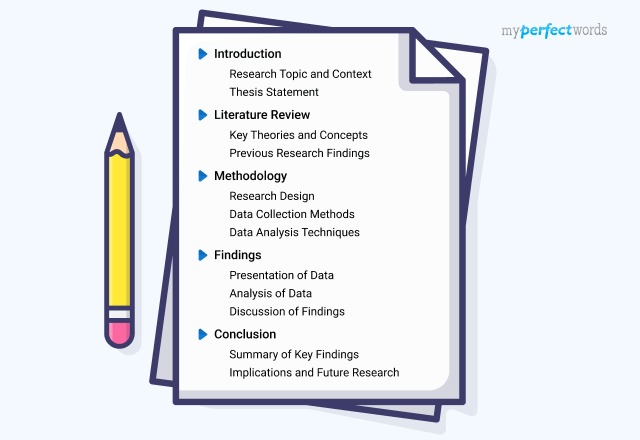
An abstract is a 150 to 250 word summary of your entire paper, written last, even though it appears first. It covers your research question, method, main findings, and conclusion in condensed form. It should stand alone; a reader should understand your paper's purpose and outcome just from the abstract.
| For a full breakdown, see how to write an abstract for a research paper. |
Literature Review
A literature review synthesizes existing research on your topic; it's not a summary of sources, it's an analysis of what the existing research says, where it agrees, where it conflicts, and what gaps remain. Most literature reviews are organized thematically, not source-by-source.
| For how to write one from scratch, see how to write a literature review. |
Methodology
The methodology section explains how you conducted your research, your research design, how you collected data, how you analyzed it, and why those choices were appropriate for your question. Readers should be able to replicate your study from this section alone.
| For writing guidance, see research paper methodology. |
Conclusion
A strong conclusion does three things: restates your thesis (in different words), summarizes your key findings, and explains the broader significance of your research. It doesn't introduce new evidence. It closes the argument you opened in the introduction.
| For a full breakdown, see the research paper conclusion. |
Struggling With Your Research Paper?
Our expert writers handle any section, any format, any deadline.
Join thousands of students who've trusted us with their deadlines.
Research Paper Examples for Different Fields
Different academic fields have different conventions; what counts as strong evidence in psychology isn't the same as what's expected in a history paper. Here's what to look for in examples from each subject.
History Research Paper Sample
History papers rely heavily on primary sources (letters, diaries, government documents, newspapers) alongside secondary analysis. The argument is usually interpretive; you're explaining why something happened or what it meant, not just describing events. The Chicago style is most common. Notice how the example uses footnotes to credit sources and how the thesis stakes a specific interpretive claim.
| Check out the history research paper topics blog to get inspired and motivated by these amazing ideas. |
Sociology Research Paper Sample
Sociology papers often blend quantitative data with theoretical frameworks. You'll typically see an explicit theory section, data analysis with tables or statistics, and a discussion connecting findings back to the theory. APA is the standard format.
Science and Biology Research Paper Sample
Science papers prioritize precision and replicability. The methodology section is especially detailed, and results are presented with data visualizations (graphs, charts, tables) before being interpreted in a discussion section. APA or a field-specific style (like ACS for chemistry) is common.
Psychology Research Paper Sample
Psychology papers follow APA format strictly and often use the IMRaD structure: Introduction, Methods, Results, and Discussion. Notice how results are reported with specific statistical values (mean, standard deviation, p-values) and how the discussion interprets those numbers rather than just restating them.
Art History Research Paper Sample
Art history papers center on formal analysis (describing the visual elements of a work) alongside historical context and interpretation. Chicago style is the norm. The thesis is usually an argument about what a work means or how it fits within a broader artistic or cultural moment.
Research Paper Examples by Academic Level
The expectations for a research paper shift significantly depending on where you are in your academic career. Here's what distinguishes papers at each level.
High School Research Paper Example
High school papers typically run 3 to 5 pages and rely on secondary sources. The thesis is usually straightforward, and the argument doesn't require original research. Formatting is often MLA. Professors at this level are primarily evaluating whether you can construct a coherent argument and cite sources correctly.
Undergraduate Research Paper Example
Undergraduate papers are longer (typically 8 to 20 pages depending on the course), require more sources, and are expected to engage more seriously with the existing literature. A stronger thesis is expected, one that takes a debatable position, not just a descriptive one. Both primary and secondary sources are often required.
Graduate-Level Research Paper Example
Graduate papers are expected to make an original contribution to the field. They run significantly longer, require a thorough literature review, often include original data collection or analysis, and are written for an academic audience rather than a general one. The thesis needs to say something genuinely new, not just synthesize what others have said.
Tips to Use a Research Paper Example Effectively
Most students use examples the wrong way. They skim one, feel a vague sense of reassurance, and then start writing. That's not how you actually learn from an example.
Here's how to use them strategically:
Study the structure, not just the content
Read the example once for the argument. Then read it again, specifically to track the structure, where does the thesis appear? How does each section transition to the next? How long is each section relative to the whole?
Analyze how citations are integrated
Don't just notice that citations exist. Look at where they're placed within a sentence or paragraph, how the writer introduces quoted material, and how they explain what a citation means rather than just dropping it in.
Compare multiple examples to find field norms
One psychology example might be an outlier. Three examples show you the pattern. If all three open with a definition and a research question, that's a convention worth following.
Use the introduction and conclusion as structural models
These two sections are the hardest to write and the most formulaic. A strong example shows you the pattern, context, problem, thesis in the intro; restatement, summary, significance in the conclusion.
Check the formatting details before you submit
Margins, font, spacing, header format, and how the title page is laid out are all of this is in the example, and all of it is checked by your professor. Don't skip this step.
The best research paper examples don't just show you what to do, they show you what a finished, polished paper actually looks like in your specific field.
| One thing that trips students up: knowing whether their assignment calls for a research paper or a research essay. They're different formats with different expectations; see our guide on the research paper vs essay for a full breakdown. |
Conclusion
Research paper examples are one of the most underused tools students have. Most people glance at one, convince themselves they understand the format, and then spend hours second-guessing every section they write.
The better approach is to treat examples like a blueprint. Study the structure, pay attention to how sources get integrated, and compare multiple papers from your field before you write a single word of your own. The more familiar you are with what a finished paper looks like, the easier it is to close the gap between what you've written and what your professor expects.
If you've got the concept down but you're still staring at a blank page, that's exactly what our service is here for. Our writers have advanced degrees in 50+ fields and have written thousands of research papers across every format and subject.
Ready to Submit a Paper You're Proud Of?
Our human writers craft research papers that meet your exact requirements.
- Custom research papers written from scratch, never recycled
- All formats covered: APA, MLA, Chicago, Harvard
- 3-hour rush available for urgent deadlines
- Expert writers with advanced degrees
From first draft to final submission, we've got you covered.
Place an Order
-20615.png)
-20655.png)
-20737.png)
-9374.jpg)


-20592.png)
 (1))
-20591.png)

-20668.png)
-20612.png)
-20657.png)


-20577.png)
-20575.png)


-20578.png)



 (2))
)
 (1))
 (1))
 (1))
 (1))
 (1))
 (1))
-20419.png)
-20426.png)
-20431.png)
-20738.png)
-20739.png)
-20745.png)
-20755.png)