What Is an Analytical Essay?
Unlike a summary that simply describes content, an analytical essay interprets meaning, identifies patterns, and presents an argument about significance.
The goal is not to prove a subject right or wrong, but to develop a deeper understanding of how it works and what it means. You'll use evidence from primary sources, secondary sources, or both to support your interpretation.
Here's the difference:
Summary: "The book is about a man who chases a dream." Analysis: "Fitzgerald uses Gatsby's obsessive pursuit of wealth to critique the American Dream, showing how materialism corrupts authentic human connection." See? The summary describes. Analysis interprets and explains significance. |
Key characteristics of analytical essays:
- Focused analysis rather than broad summary
- Clear thesis statement presenting your interpretation
- Evidence-based arguments supporting your claims
- Critical thinking that goes beyond surface observations
- Logical organization connecting ideas cohesively
| The key distinction: you're not just saying WHAT something is. You're explaining HOW it works and WHY it matters. |
Types of Analytical Essays
Analytical essays come in various forms depending on what you're analyzing and your academic discipline. Understanding these types helps you approach your specific assignment with the right analytical framework.
Literary Analysis Essay
A literary analysis essay examines elements of literature such as theme, character development, symbolism, narrative structure, or literary devices. You analyze how the author uses these elements to create meaning and achieve specific effects.
To analyze literature, themes, and symbolism, check out our literary analysis essay guide
For specialized literary analysis approaches, see our guides on character analysis and poetry analysis essays.
Rhetorical Analysis Essay
This type analyzes how authors or speakers use rhetorical strategies (ethos, pathos, logos) to persuade their audience. You examine the effectiveness of arguments, appeals, tone, and stylistic choices in speeches, advertisements, articles, or other persuasive texts.
To examine persuasive techniques in speeches, ads, or texts, check our rhetorical analysis essay guide.
Process Analysis Essay
A process analysis breaks down how something works or how to do something step-by-step. This can be informational (explaining how photosynthesis occurs) or instructional (teaching readers how to change a tire).
To explain how something works step by step, check out our process analysis essay guide.
Critical Analysis Essay
Critical analysis involves evaluating the strengths and weaknesses of a text, theory, or argument. You assess the validity of claims, quality of evidence, logical coherence, and overall effectiveness while acknowledging multiple perspectives.
To study how critical argument is developed and what they represent, check out our critical essay guide.
Causal Analysis Essay
This type examines cause-and-effect relationships to understand why something happened or what consequences resulted from specific events or conditions. You analyze contributing factors, immediate and long-term effects, and the significance of these relationships.
Visual Analysis: Examines images, art, or visual media.
Each type uses the same core analytical skills but applies them to different subjects.
Understanding Your Assignment
Before you begin writing, carefully analyze your assignment prompt. Look for keywords that indicate what type of analysis you should perform:
- Analyze: Break down into components and examine relationships
- Examine: Look closely at specific elements or features
- Interpret: Explain mthe eaning and significance
- Evaluate: Assess effectiveness or quality (moves toward critique)
- Compare/Contrast: Identify similarities and differences to reveal insights
Also note any specific requirements about sources, length, formatting, and whether you need to focus on particular aspects of the subject.
How to Write an Analytical Essay (Step by Step)
Follow these steps to develop a strong analytical essay from initial reading to final draft.
Step 1: Read and Annotate Your Source Material
Begin by reading your source material carefully whether it's a literary text, article, speech, or other subject of analysis. Don't just read passively; engage actively with the content.
Effective annotation techniques:
- Highlight key passages, quotes, and evidence
- Make marginal notes about patterns, themes, or techniques
- Mark confusing sections to revisit
- Note your initial reactions and questions
- Identify rhetorical devices, literary techniques, or structural elements
Read the material multiple times if possible. First readings capture general understanding; subsequent readings reveal deeper patterns and nuances you'll analyze in your essay.
Browse the complete list of our comprehensive analytical essay topics blog features over 240 topic ideas organized by category and academic level to find topics that match your interests and assignment requirements.
Step 2: Develop Your Thesis Statement
Your thesis statement is the central argument of your analytical essay. It should present a specific, debatable interpretation of the subject not a simple fact or observation.
Strong analytical thesis characteristics:
- Specific: Focuses on particular elements rather than broad generalizations
- Arguable: Presents an interpretation others could reasonably debate
- Analytical: Explains how or why, not just what
- Focused: Narrow enough to support thoroughly in your essay length
strong thesis:
"Through Hamlet's procrastination and philosophical soliloquies, Shakespeare demonstrates that overthinking and moral complexity paralyze decisive action, ultimately causing more harm than the original wrong."
This thesis is specific, arguable, and explains how specific literary elements create meaning.
For detailed guidance on crafting effective thesis statements, see our analytical essay thesis statement guide.
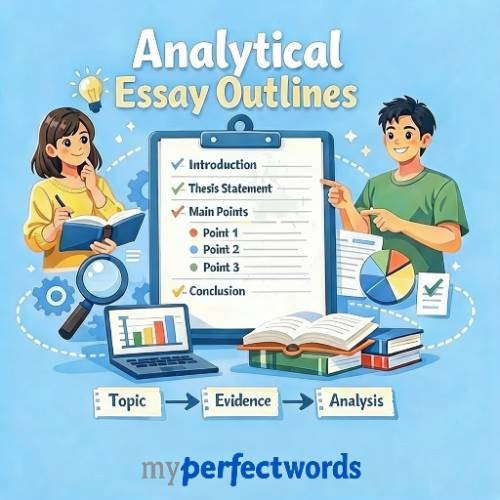
Step 3: Create an Outline
An outline provides structure for your analysis and ensures logical flow. It helps you organize evidence, develop supporting points, and maintain focus on your thesis.
Each body paragraph should include a topic sentence, evidence from sources, analysis of that evidence, and a transition to the next point.
Step 4: Write Your Introduction
Your introduction should engage readers, provide necessary context, and clearly present your thesis. Avoid lengthy summaries of the entire text provide only the background information readers need to understand your argument.
Effective introduction elements:
- Hook: Start with an interesting question, quote, or observation that relates to your analysis
- Context: Briefly introduce the subject you're analyzing (title, author, publication date, relevant background)
- Thesis: End with your clear thesis statement
- Roadmap (optional): In longer essays, preview the main points you'll cover
Step 5: Develop Body Paragraphs
Body paragraphs form the core of your analytical essay. Each paragraph should advance your thesis by examining one specific aspect of your subject.
Body paragraph structure:
- Topic Sentence: State the main point of this paragraph and how it supports your thesis
- Evidence: Present specific examples, quotes, or data from your source
- Analysis: This is the most important part explain what the evidence means and how it supports your argument. Don't just present evidence; interpret it.
- Connection: Link back to your thesis to show how this point contributes to your overall argument
- Transition: Connect smoothly to the next paragraph
Common mistake to avoid: Many students present evidence but fail to analyze it sufficiently. Your analysis should be longer and more detailed than your evidence quotes. Ask yourself: "So what? Why does this matter? What does this reveal?" |
Step 6: Write Your Conclusion
Your conclusion synthesizes your analysis and reinforces the significance of your argument. Don't simply restate your thesis word-for-word or summarize each body paragraph.
Effective conclusion strategies:
- Restate your thesis in fresh language that reflects the depth of analysis you've provided
- Synthesize your main points to show how they work together
- Address broader implications or significance of your analysis
- End with a thought-provoking final statement that gives readers closure
| Avoid introducing completely new information in your conclusion, but do aim to elevate your discussion beyond where it started. |
Step 7: Revise and Edit
Revision is where good essays become great. Set your draft aside for at least a few hours (ideally a day) before revising with fresh eyes.
Revision checklist:
- Thesis clarity: Is your thesis specific, arguable, and clearly stated?
- Evidence: Have you provided sufficient, relevant evidence for each claim?
- Analysis depth: Does your analysis go beyond surface observations?
- Organization: Do paragraphs flow logically? Are transitions smooth?
- Grammar and mechanics: Check for errors in spelling, punctuation, and sentence structure
- Citations: Are all sources properly cited in the required format?
Consider reading your essay aloud to catch awkward phrasing and identify areas where your argument isn't clear.
Affordable Expert Analysis
Premium Analytical Essays at Student Friendly Prices
Get expert-written analytical essays that fit your budget perfectly.
Analytical Essay Basic Structure
Understanding the standard structure helps you organize your analysis effectively. While you can adapt this structure to fit specific assignments, this framework provides a solid foundation.
Introduction Structure
Length: Typically 1 paragraph (10-15% of total essay)
Components:
- Opening hook to engage readers
- Background context about the subject
- Clear thesis statement (usually the last sentence)
Body Paragraphs Structure
Length: 3-5 paragraphs (70-80% of total essay)
Each paragraph should:
- Begin with a clear topic sentence
- Present specific evidence (quotes, examples, data)
- Provide detailed analysis of that evidence
- Connect back to the thesis
- Transition smoothly to the next point
Conclusion Structure
Length: 1 paragraph (10-15% of total essay)
Components:
- Restatement of thesis in fresh language
- Synthesis of main analytical points
- Broader implications or significance
- Closing thought that provides satisfying closure
For complete structural templates and examples, visit our analytical essay outline.
Opening Strategies for Analytical Essay That Work
Surprising fact or statistic: "Despite spending $150 billion annually on advertising, 86% of viewers skip commercials yet Super Bowl ads still command $7 million for 30 seconds."
Thought-provoking question: "Why does Hamlet, consumed by revenge, spend four acts avoiding it?"
Relevant quote: "'So we beat on, boats against the current' Fitzgerald's final line captures Gatsby's central tragedy."
Vivid context: "In 1925, America was drunk on prosperity and promise. Fitzgerald's Gatsby exposed the hangover."
| Choose the hook that best fits your subject and angle. Then provide 2-3 sentences of context and end with your thesis. |
What to Include in Your Intro
Your introduction needs three elements:
- Hook (1-2 sentences): Grab attention
- Context (2-3 sentences): Background reader needs
- Thesis (1 sentence): Your analytical claim
What NOT to do: Start with "In this essay, I will..." or dictionary definitions. Get to your argument quickly.
See how strong intros work in practice? Check out our analytical essay examples to see what works.
How to Write a Conclusion for an Analytical Essay
Your conclusion does more than summarize. It should leave readers with a clear understanding of why your analysis matters.
The Three-Part Formula
1. Restate your thesis (1 sentence)
Don't copy your introduction. Rephrase your argument, emphasizing the conclusions your analysis reached.
Original thesis: "Fitzgerald uses Gatsby's downfall to critique the American Dream."
Conclusion restatement: "Through Gatsby's tragic pursuit of wealth and status, Fitzgerald exposes the American Dream as a corrupting force that destroys authentic connection."
2. Synthesize your main points (2-3 sentences)
Briefly recap the key insights from your analysis. Show how they work together to prove your thesis.
"The green light symbolizing unreachable desire, the contrast between West and East Egg revealing insurmountable class barriers, and Daisy's 'voice full of money' equating human worth with wealth, each element builds Fitzgerald's critique."
3. Explore broader significance (1-2 sentences)
Answer the "so what?" Why should readers care about your analysis? What implications does it have?
"A century after Gatsby's publication, Americans still chase the same illusion, believing the right house, car, or income will finally deliver belonging. Fitzgerald suggests this pursuit doesn't just fail; it prevents us from recognizing the connections we already have."
Tips for Writing Strong Analytical Essays
Stay Focused on Analysis, Not Summary
The most common mistake in analytical essays is excessive plot summary or description. Your readers likely already know the basic content they want to understand your interpretation.
Summarize only what's necessary to support your analysis.
Use Strong Topic Sentences
Each body paragraph's topic sentence should make a claim that advances your thesis. Weak topic sentences merely announce what you'll discuss ("The next technique is symbolism").
Strong topic sentences argue a point ("Shakespeare's use of poison symbolizes the corruption spreading through Denmark's court").
Integrate Quotes Smoothly
Don't drop quotes into your essay without introduction or explanation. Use signal phrases to integrate them grammatically and contextually.
Always follow quotes with analysis never let a quote speak for itself or end a paragraph with an unanalyzed quote.
Analyze, Don't Just Observe
Observation identifies what's there ("The author uses metaphors"). Analysis explains why it matters and what it reveals ("The author's extended metaphor comparing time to a thief emphasizes the speaker's anxiety about mortality and lost opportunities").
Always push beyond identifying techniques to explaining their purpose and effect.
Maintain Objectivity
Use third-person perspective and avoid phrases like "I think" or "I believe." Your analysis should be presented as reasoned interpretation supported by evidence, not personal opinion.
Instead of "I think the character is selfish," write "The character's repeated refusal to help others reveals his selfishness."
Address Complexity and Nuance
Strong analytical essays acknowledge complexity rather than oversimplifying. If there are multiple valid interpretations, address them.
Use qualifiers like "primarily," "suggests," or "one interpretation" when appropriate. This demonstrates sophisticated thinking.
Use Precise Analytical Language
Choose verbs that indicate analysis and interpretation: demonstrates, reveals, suggests, implies, emphasizes, illustrates, reflects, and reinforces.
Avoid vague or weak verbs like "shows" or "talks about." Precise language strengthens your analytical authority.
Common Analytical Essay Mistakes to Avoid
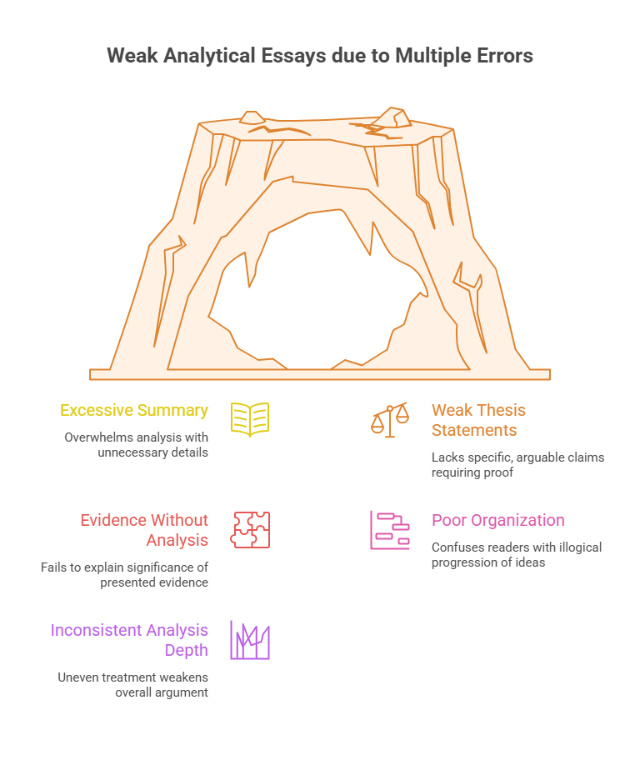
- Plot summary instead of analysis: Don't retell the story, interpret it
- Weak or missing thesis: Every analytical essay needs a clear, specific argument
- Insufficient evidence: Support every analytical claim with specific examples
- Lack of analysis after evidence: Explain what evidence means; don't let it speak for itself
- Poor organization: Each paragraph should have one clear focus
- Introducing new ideas in conclusion: Conclusions synthesize, they don't present new arguments
- Ignoring assignment requirements: Always follow specified format, length, and citation style
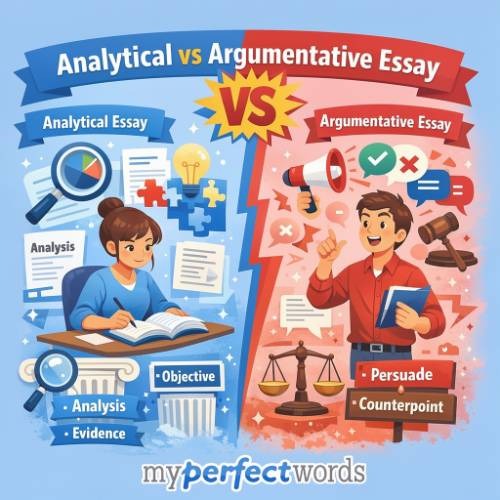
Analytical vs Argumentative Essay: Key Differences
Students often confuse analytical and argumentative essays because both require a thesis and evidence. However, they serve different purposes and use distinct approaches.
Analytical Essay:
- Purpose: Examine how something works or what it means
- Approach: Break down, interpret, explain
- Stance: Objective interpretation based on evidence
- Example: "Shakespeare uses soliloquies to reveal Hamlet's internal conflict"
Argumentative Essay:
- Purpose: Persuade readers to accept a position on a debatable issue
- Approach: Take a stance, present reasons, address counterarguments
- Stance: Advocate for a particular viewpoint
- Example: "Schools should ban smartphones during class hours because they distract from learning"
Key distinction:
Analytical essays explain and interpret existing material. Argumentative essays advocate for a position on a contemporary issue or debate. An analytical essay about gun control would analyze how different rhetorical strategies are used in the debate; an argumentative essay would argue for or against specific gun control policies.
For a detailed comparison with examples, see our complete guide on analytical vs argumentative essays.
Bottom Line
An analytical essay is your chance to show you can think critically about a topic, not just summarize it. Focus on your thesis, support it with evidence, and always explain the "so what."
The key is moving beyond observation to interpretation. Don't just tell readers what the text says or what happened. Explain what it means, why it matters, and what it reveals about your subject.
Whether you write it yourself or get help, the goal is the same: turn in something you're proud of. And do you need backup? We're here.
Still stuck? Get analytical essay help from our experts, thesis, structure, analysis, all of it handled for you.
GET YOUR ESSAY DONE
Our writers deliver polished analytical essays—researched, structured, and ready to submit.
- 100% human-written
- Delivered on time, every time
- Unlimited revisions
- Private & Confidential
Free revisions until you're 100% satisfied.
Order Now