MyPerfectWords - Essay Writing Service
  • Writers
  • Services

      Essays

    • College Essay
    • Argumentative Essay
    • Expository Essay
    • Narrative Essay
    • Descriptive Essay
    • Scholarship Essay
    • Admission Essay
    • Reflective Essay
    • Nursing Essay
    • Law Essay
    • Economics Essay
    • … and more!

      Assignments

    • Term Papers
    • Reports
    • Coursework
    • Speeches
    • Research Papers
    • Case Studies
    • Dissertation
    • Presentation
    • Write My Assignment

      Other

    • Editing Help
    • Buy Essays
    • Cheap Essay Writing
  • About Us
  • Pricing
  • Samples
  • Blog
Place an Order
  • Login
  • Signup
MyPerfectWords - Essay Writing Service
MPW Logo
  • Writers IconWriters
  • Services IconServices

      Essays

    • College Essay
    • Argumentative Essay
    • Expository Essay
    • Narrative Essay
    • Descriptive Essay
    • Scholarship Essay
    • Admission Essay
    • Reflective Essay
    • Nursing Essay
    • Law Essay
    • Economics Essay
    • … and more!

      Assignments

    • Term Papers
    • Reports
    • Coursework
    • Speeches
    • Research Papers
    • Case Studies
    • Dissertation
    • Presentation
    • Write My Assignment
    • Other

    • Editing Help
    • Buy Essays
    • Cheap Essay Writing
  • About Us IconAbout Us
  • Pricing IconPricing
  • Blog IconBlog
  • Account IconAccount
    • Login
    • Sign Up
Place an Order
Email Iconinfo@myperfectwords.comPhone Icon(+1) 888 687 4420

Home

>

Blog

>

Analytical Essay Guide

>

Analytical Essay Outline

Analytical Essay Outline Guide | Templates & Examples

NA

Written ByNova A.

Reviewed By Catherine R.

10 min read

Published: Dec 10, 2025

Last Updated: Dec 10, 2025

analytical essay outline

Analytical essay outlines organize arguments before drafting, preventing organizational problems and ensuring logical flow. Outlines map thesis statements, body paragraph topics, evidence for each point, analysis connecting evidence to thesis, and transitions between ideas. Creating outlines before writing saves time during drafting and revision by establishing clear direction and logical progression.

Effective outlines balance structure with flexibility—providing organizational framework without constraining thinking completely. They help identify weak points before drafting, ensure adequate evidence for each claim, prevent redundancy between paragraphs, and maintain focus on thesis throughout essays.

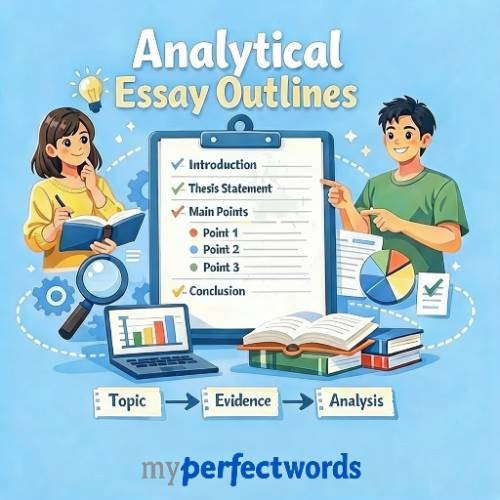
Standard analytical essay outlines follow five-paragraph structure including:

  1. Introduction with hook, context, and thesis.
  2. Three body paragraphs each developing one thesis-supporting point with topic sentence, evidence, and analysis.
  3. Conclusion restating thesis and synthesizing insights.

Complex essays expand this structure with additional body paragraphs while maintaining the same organizational principles.

Each body paragraph outline should include:

  • Topic sentence announcing the point.
  • Evidence quotes or examples with citations.
  • Analysis explaining significance (typically 2-3 analytical points per evidence piece).
  • Transition to next paragraph.

Create detailed outlines showing not just topics but specific evidence and analytical points you'll develop, ensuring you have adequate material before drafting.

Expert Analysis • Professional Writers

Struggling with Deep Analysis? Our Experts Can Help

Get Expert Analysis Help

Get expert-written analytical essays that impress professors and earn top grades.

Why Create Analytical Essay Outlines

Outlines transform vague ideas into structured arguments before you invest time in full drafting. This pre-writing organization prevents common problems plaguing analytical essays.

Without outlines, writers often discover organizational problems after drafting—paragraphs in illogical order, redundant points across paragraphs, insufficient evidence for claims, or unclear connections between ideas. Fixing these structural issues requires extensive revision, essentially rewriting essays from scratch. 

Outlines catch these problems early when reorganization takes minutes rather than hours. You can rearrange outline points instantly, identify weak arguments needing better evidence, and ensure logical progression before writing full paragraphs.

Outlines also combat writer's block. Staring at blank pages wondering what to write next paralyzes many writers. With outlines, you always know what comes next—following your predetermined plan rather than inventing structure while drafting.

Additionally, outlines ensure comprehensive thesis support. You can verify each body paragraph connects to your thesis clearly, that you're not repeating points unnecessarily, and that evidence actually supports claims you're making. This verification process strengthens arguments significantly.

Expert Tip

Struggling to structure your analytical essay? Get expert outline assistance from professional analytical writing service.

Outlines for Different Analytical Types

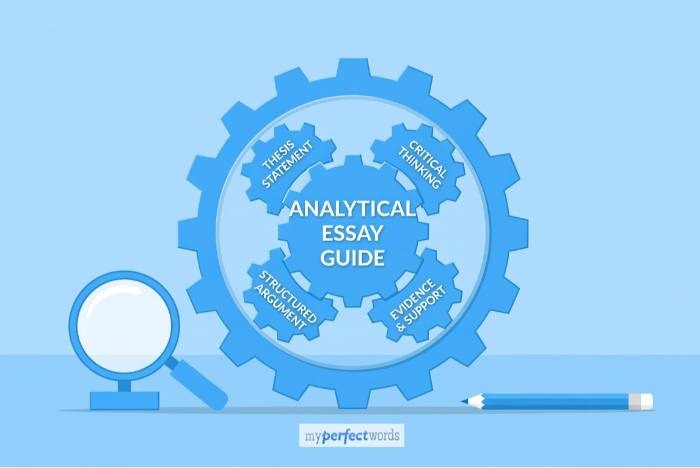
Different analytical essay types require different outlining approaches. Literary analysis outlines organize textual evidence by themes, symbols, or techniques. Rhetorical analysis outlines structure evaluation of persuasive strategies. Process analysis outlines sequence steps logically. Comparative analysis outlines organize similarities and differences systematically. Our comprehensive analytical essay guide provides detailed, step-by-step instructions to help you master the art of writing a perfect analytical essay.

Match your outline structure to your analytical type. Don't force literary analysis into process analysis organization or vice versa. Effective outlines reflect analytical approaches appropriate for specific subjects and assignments.

Standard Analytical Essay Outline Structure

Most analytical essays follow five-paragraph structure. Understanding this standard framework helps you outline effectively even when expanding beyond five paragraphs.

Introduction Outline Components

Introduction outlines should specify three elements: hook strategy, context you'll provide, and exact thesis statement.

Hook: Note your attention-grabbing opening approach. Will you start with a provocative question? A surprising fact? A relevant brief anecdote? A bold claim? Deciding this beforehand prevents generic openings like "Throughout history..." appearing in first drafts.

Context: List specific background information readers need. For literary analysis, note author and work identification. For rhetorical analysis, specify speaker, audience, and occasion. For process analysis, establish why this process matters. Be specific—"provide historical context" is too vague; "explain photosynthesis's discovery in 1770s" specifies exactly what context you'll include.

Thesis Statement: Write your complete thesis statement in your outline. Don't note "thesis goes here"—actually draft it. Thesis statements guide entire essays, so finalizing them during outlining ensures all body paragraphs support clear claims. If you can't articulate thesis during outlining, you're not ready to draft.

Body Paragraph Outline Components

Each body paragraph outline should include four elements: topic sentence, evidence list, analysis points, and transition note.

Topic Sentence: Write complete topic sentences announcing each paragraph's focus. Topic sentences function like mini-theses for individual paragraphs, making specific claims requiring support. Vague notes like "discuss symbolism" don't help during drafting. Complete topic sentences like "Shakespeare's blood imagery intensifies throughout Macbeth as guilt accumulates" provide direction.

Evidence: List specific evidence you'll use with citations. For literary analysis, note exact quotes with page numbers. For rhetorical analysis, reference specific passages or examples. For process analysis, list steps you'll explain. Having evidence identified during outlining ensures you have adequate support before drafting.

Analysis Points: Outline 2-3 specific analytical observations about each evidence piece. What does this evidence mean? Why does it matter? How does it support your topic sentence and thesis? These analytical notes become your paragraph's substance during drafting. Without them, you risk writing evidence-heavy paragraphs with minimal interpretation.

Transition: Note how this paragraph connects to the next. Transitions might show progression (moving from one technique to another), contrast (showing different aspects), or causation (showing how one point leads to another). Planning transitions during outlining creates smoother logical flow than inventing connections while drafting.

Conclusion Outline Components

Conclusion outlines specify: thesis restatement approach, main points you'll synthesize, and closing insight you'll offer.

Thesis Restatement: Note how you'll restate your thesis using different words emphasizing conclusions your analysis reached. Don't just copy your introduction thesis—rephrase it reflecting understanding you've demonstrated through analysis.

Synthesis: List 2-3 key insights from body paragraphs you'll synthesize. Conclusions shouldn't merely list points already made—they should show how points collectively support your thesis and what larger understanding emerges.

Closing Insight: Note final thought you'll offer. What implications does your analysis reveal? What questions does it raise? What broader significance does it hold? Strong closings leave readers with clear understanding of your analysis's importance rather than abrupt endings.

Literary Analysis Essay Outline Template

Literary analysis examines how authors create meaning through themes, symbols, imagery, character development, or narrative techniques.

Template Structure

I. Introduction

  1. Hook: [Note specific attention-grabbing opening]
  2. Context: Author, work title, brief relevant background
  3. Thesis: [Complete thesis statement making analytical claim about literary element]

II. Body Paragraph 1

  1. Topic Sentence: [First way author develops your analyzed element]
  2. Evidence A: Quote with citation [page number]
  3. Analysis point 1: [What this reveals]
  4. Analysis point 2: [Why this matters]
  5. Analysis point 3: [How this supports thesis]
  6. Evidence B: Quote with citation [page number]
  7. Analysis point 1: [What this reveals]
  8. Analysis point 2: [Why this matters]
  9. Transition: [How this connects to next paragraph]

III. Body Paragraph 2

  1. Topic Sentence: [Second way author develops your analyzed element] - Evidence A: Quote with citation [page number]
  2. Analysis point 1: [What this reveals]
  3. Analysis point 2: [Why this matters]
  4. Analysis point 3: [How this supports thesis]
  5. Evidence B: Quote with citation [page number]
  6. Analysis point 1: [What this reveals]
  7. Analysis point 2: [Why this matters]
  8. Transition: [How this connects to next paragraph]

IV. Body Paragraph 3

  1. Topic Sentence: [Third way author develops your analyzed element]
  2. Evidence A: Quote with citation [page number]
  3. Analysis point 1: [What this reveals]
  4. Analysis point 2: [Why this matters]
  5. Analysis point 3: [How this supports thesis]
  6. Evidence B: Quote with citation [page number]
  7. Analysis point 1: [What this reveals]
  8. Analysis point 2: [Why this matters]
  9. Transition: [Lead into conclusion]

V. Conclusion

  1. Thesis restatement: [Rephrase emphasizing what analysis proved]
  2. Synthesis: [Key insights from body paragraphs]
  3. Closing thought: [Broader significance or implications]

Example Outline: Symbol Analysis

I. Introduction

  1. Hook: "Some literary symbols carry singular meanings; others accumulate significance throughout narratives."
  2. Context: F. Scott Fitzgerald's The Great Gatsby (1925), Jazz Age America
  3. Thesis: "Fitzgerald's green light symbolizes not only Gatsby's personal dream of reclaiming Daisy but also the broader American Dream's promise and corruption, functioning as the novel's central symbol connecting individual desire to national mythology."

II. Body Paragraph 1: Green Light as Personal Dream

  1. Topic Sentence: The green light first appears representing Gatsby's specific romantic yearning for Daisy and the past.
  2. Evidence A: "He stretched out his arms toward the dark water...a single green light" (21)
  3. Analysis 1: Physical reaching symbolizes emotional yearning
  4. Analysis 2: Distance between Gatsby and light represents unbridgeable gap between present and past
  5. Analysis 3: Green color connects desire to money
  6. Evidence B: Gatsby believes in the light's promise despite its unattainability
  7. Analysis 1: Demonstrates his romantic idealism
  8. Analysis 2: Foreshadows tragic ending
  9. Transition: Beyond personal significance, the light accumulates broader symbolic meaning.

III. Body Paragraph 2: Green Light as American Dream

  1. Topic Sentence: As narrative progresses, green light expands symbolically to represent the American Dream's promise.
  2. Evidence A: Connection between Gatsby's pursuit of wealth to win Daisy mirrors America's material aspirations
  3. Analysis 1: Personal dream reflects national dream
  4. Analysis 2: Both conflate material success with happiness
  5. Analysis 3: Suggests American Dream's corruption
  6. Evidence B: Gatsby's methods (bootlegging) parallel American capitalism's moral compromises
  7. Analysis 1: Reveals means versus ends conflicts
  8. Analysis 2: Questions whether any dream justifies unethical methods
  9. Transition: The novel's conclusion crystallizes the symbol's ultimate meaning.

IV. Body Paragraph 3: Green Light as Eternal Human Striving

  1. Topic Sentence: Nick's final meditation reveals the green light symbolizes not just American or personal dreams but universal human yearning.
  2. Evidence A: "Gatsby believed in the green light, the orgastic future that year by year recedes before us" (180)
  3. Analysis 1: Extends symbol beyond Gatsby specifically to "us" generally
  4. Analysis 2: "Recedes before us" suggests all dreams remain unattainable
  5. Analysis 3: Yet we can't help believing—defines human condition
  6. Evidence B: Final image: "boats against the current, borne back ceaselessly into the past" (180)
  7. Analysis 1: We reach toward future while trapped by past
  8. Analysis 2: Struggle defines humanity despite inevitable failure
  9. Transition: These layers of meaning establish the green light's symbolic power.

V. Conclusion

  1. Thesis restatement: The green light's genius lies in its layered meanings progressing from personal to national to universal significance. 
  2. Synthesis: Fitzgerald uses one concrete image to convey multiple meanings about desire, disillusionment, and human nature. The light works on literal level (dock light), personal level (Gatsby's dream), national level (American Dream), and philosophical level (human striving).
  3. Closing thought: The gap between dreams and reality ultimately defines us—we reach toward green lights even when reaching proves futile.

Want to see analytical writing in action? Check out our collection of analytical essay examples that demonstrate effective analysis techniques across various types and disciplines. These real-world samples show you how successful writers structure arguments, integrate evidence, and develop insightful interpretations.

Rhetorical Analysis Essay Outline Template

Rhetorical analysis evaluates how speakers, writers, or creators use persuasive techniques to influence audiences.

Template Structure

I. Introduction

  1. Hook: [Attention-grabbing statement about rhetoric or persuasion]
  2. Context: Speaker/writer, audience, occasion, purpose
  3. Thesis: [Analytical claim about rhetorical strategies and their effectiveness]

II. Body Paragraph 1: Ethos (Credibility Appeals)

  1. Topic Sentence: [How speaker establishes credibility]
  2. Evidence A: Specific example with citation
  3. Analysis 1: What credibility this establishes
  4. Analysis 2: Why audience finds this credible
  5. Analysis 3: How this serves persuasive purpose
  6. Evidence B: Second credibility strategy
  7. Analysis 1: Additional credibility established
  8. Analysis 2: Connection to audience values
  9. Transition: Beyond credibility, speaker creates emotional connection.

III. Body Paragraph 2: Pathos (Emotional Appeals)

  1. Topic Sentence: [How speaker creates emotional responses]
  2. Evidence A: Specific emotional appeal with citation
  3. Analysis 1: What emotion this evokes
  4. Analysis 2: Why this emotion serves argument
  5. Analysis 3: How audience responds emotionally
  6. Evidence B: Second emotional technique
  7. Analysis 1: Additional emotional response created
  8. Analysis 2: Cumulative emotional effect
  9. Transition: Alongside emotional appeals, speaker provides logical reasoning.

IV. Body Paragraph 3: Logos (Logical Appeals)

  1. Topic Sentence: [How speaker constructs logical arguments]
  2. Evidence A: Example of logical reasoning with citation
  3. Analysis 1: What logical structure this uses
  4. Analysis 2: How evidence supports claims
  5. Analysis 3: Whether reasoning proves convincing
  6. Evidence B: Additional logical appeal
  7. Analysis 1: Further logical support
  8. Analysis 2: Overall argumentative strength
  9. Transition: These combined appeals create persuasive power.

V. Conclusion

  1. Thesis restatement: [Rephrase emphasizing rhetorical effectiveness]
  2. Synthesis: [How ethos, pathos, and logos work together]
  3. Closing thought: [Broader implications about rhetoric or persuasion]

Process Analysis Essay Outline Template

Process analysis explains how systems work or how to accomplish tasks.

Template Structure

I. Introduction

  1. Hook: [Why understanding this process matters]
  2. Context: Process overview and significance
  3. Thesis: [Analytical claim about how/why process works]

II. Body Paragraph 1: First Stage/Step

  1. Topic Sentence: [What first stage accomplishes]
  2. Evidence: Specific details of step
  3. Analysis 1: Why this step comes first
  4. Analysis 2: What this step enables
  5. Analysis 3: How this connects to overall process
  6. Transition: This initial stage enables subsequent steps.

III. Body Paragraph 2: Second Stage/Step

  1. Topic Sentence: [What second stage accomplishes]
  2. Evidence: Specific details of step
  3. Analysis 1: How this builds on previous step
  4. Analysis 2: What this stage achieves
  5. Analysis 3: Why this sequence matters
  6. Transition: This intermediate stage leads to final results.

IV. Body Paragraph 3: Final Stage/Step

  1. Topic Sentence: [What final stage accomplishes]
  2. Evidence: Specific details of step
  3. Analysis 1: How this completes process
  4. Analysis 2: What end result this achieves
  5. Analysis 3: Why overall process succeeds
  6. Transition: Understanding these connected stages reveals process logic.

V. Conclusion

  1. Thesis restatement: [Rephrase emphasizing process understanding]
  2. Synthesis: [How stages work together]
  3. Closing thought: [Broader implications or applications]

Struggling to find the right topic? Our analytical essay topics guide provides a diverse range of subject options spanning literature, history, science, and current events. Whether you're analyzing a novel, evaluating a historical event, or examining social trends, you'll find inspiring ideas to launch your analytical essay.

100% Plagiarism-Free Guarantee

Original Analysis Written Just For You

Order an Original Essay

Every analytical essay is written from scratch with authentic analysis—100% original.

Comparative Analysis Essay Outline Template

Comparative analysis examines similarities and differences between subjects to reach conclusions about their relationships.

Point-by-Point Organization

I. Introduction

  1. Hook: [Why comparing these subjects matters]
  2. Context: Brief introduction to both subjects
  3. Thesis: [Analytical claim about what comparison reveals]

II. Body Paragraph 1: First Comparison Point

  1. Topic Sentence: [First aspect of comparison]
  2. Subject A evidence and analysis
  3. How Subject A handles this aspect
  4. Significance of A's approach
  5. Subject B evidence and analysis
  6. How Subject B handles this aspect
  7. Significance of B's approach
  8. Comparison analysis: Similarities, differences, why they matter
  9. Transition: Another aspect reveals further distinctions.

III. Body Paragraph 2: Second Comparison Point

  • [Same structure as Body Paragraph 1]

IV. Body Paragraph 3: Third Comparison Point

  • [Same structure as Body Paragraph 1]

V. Conclusion

  1. Thesis restatement: [What comparison ultimately reveals]
  2. Synthesis: [Overall similarities and differences significance]
  3. Closing thought: [Broader implications of comparison]

Outline Development Process

Creating effective outlines requires systematic processes rather than random brainstorming.

Step 1: Thesis Development First

Begin outlining only after developing clear thesis statements. Thesis statements guide everything else—they determine what body paragraphs you need, what evidence you'll present, what analysis you'll conduct.

If you can't articulate thesis clearly, you're not ready to outline. Return to pre-writing: read more carefully, brainstorm analytical questions, explore possible arguments. Once thesis crystallizes, outlining becomes straightforward.

Step 2: Identify Main Supporting Points

Based on your thesis, determine 3-4 main points supporting your argument. Each becomes a body paragraph. These points should be distinct rather than overlapping, logically ordered, and collectively comprehensive in proving your thesis.

For example, if your thesis claims "Shakespeare uses three types of imagery to represent guilt," your three body paragraphs analyze each imagery type. If your thesis argues "The American Dream's promise conflicts with reality," your body paragraphs might address promise elements, reality obstacles, and resulting disillusionment.

Step 3: Gather Evidence for Each Point

For each body paragraph topic, identify specific evidence supporting that point. List quotes with page numbers for literary analysis. Note examples or passages for rhetorical analysis. Document steps for process analysis. Specify comparison aspects for comparative analysis.

Gathering evidence during outlining reveals whether you have adequate support. If you can't find good evidence for a point, either research more or revise that point. Better to discover insufficient evidence now than after drafting entire paragraphs.

Step 4: Plan Analysis for Each Evidence Piece

Don't just list evidence—outline analytical points you'll make about each piece. What does this evidence mean? Why does it matter? How does it support your paragraph topic and thesis? Planning analysis during outlining ensures depth during drafting.

Many outlines list evidence but skip analysis planning. This produces evidence-heavy drafts requiring extensive analytical revision. Outline analysis now, draft more easily later.

Step 5: Arrange Logical Order

Decide paragraph order carefully. Some logical progressions work better than others depending on your argument. Consider these arrangements:

  • Chronological: Following time sequence (narrative development, historical progression)
  • Building: Starting with simpler points, progressing to complex (increasing sophistication)
  • Emphatic: Strongest evidence first or last (strategic positioning for impact)
  • Categorical: Organizing by types or categories (systematic coverage)

Expert Tip

Choose organizational patterns serving your analytical goals rather than randomly ordering paragraphs.

Step 6: Add Transitions

Plan how paragraphs connect. Note transition strategies: "Beyond establishing X, the author also Y..." or "This initial stage enables subsequent Z..." Planned transitions create smoother flow than invented transitions during drafting.

Common Outlining Mistakes

Avoid these frequent errors undermining outline effectiveness.

Vague Topic Descriptions

Outlining "discuss symbolism" or "talk about techniques" provides no direction. Write complete topic sentences making specific claims: "Blood imagery represents inescapable guilt" gives clear purpose.

Vague outlines offer minimal drafting guidance. Specific outlines act as detailed roadmaps making drafting straightforward.

Listing Without Analyzing

Outlines listing evidence without analysis planning produce evidence-heavy drafts lacking interpretation. For each evidence piece, outline 2-3 analytical observations you'll develop.

Analysis is where your thinking appears—outline it carefully rather than assuming it will emerge naturally during drafting.

Redundant Points Across Paragraphs

Sometimes outlines reveal multiple paragraphs making essentially identical points with different examples. This redundancy wastes words without advancing arguments.

If two paragraph topics overlap significantly, combine them or differentiate them more clearly. Each paragraph should advance your argument distinctly.

Insufficient Evidence

Outlines sometimes show body paragraph topics lacking adequate evidence support. If you can only identify one weak example for a point, that point probably needs reconsidering.

Strong paragraphs require multiple substantial evidence pieces thoroughly analyzed. Discovering insufficient evidence during outlining saves drafting time on unsupportable arguments.

Missing Thesis Connection

Some outlines develop interesting points tangentially related to thesis but not directly supporting it. Each body paragraph should connect clearly to your thesis—if the connection isn't obvious in your outline, readers won't see it in your essay.


Expert Tip

Test each outlined paragraph: Does this directly prove my thesis? If not, revise the paragraph or the thesis.

From Outline to Draft

Transform outlines into drafts through systematic expansion while maintaining organizational structure you've carefully planned.

Expand Systematically

Draft one section completely before moving to the next. Complete your introduction fully, then move to body paragraph one. Finish body paragraph one completely before starting body paragraph two. This systematic approach prevents half-finished sections scattered throughout essays.

Use your outline as guide but allow flexibility. If drafting reveals better phrasings, stronger evidence, or clearer analytical insights, incorporate improvements even if they deviate from outline details. Outlines provide structure; drafting develops substance.

Maintain Outline's Logic

While allowing flexibility in details, preserve your outline's organizational logic. If your outline shows logical progression from point A to point B to point C, maintain that progression during drafting. The outline's structural decisions resulted from careful thinking—trust that planning.

If drafting reveals fundamental organizational problems, stop drafting and revise your outline. Don't plow forward with flawed structure hoping it works. Fix structural issues in outline form, then resume drafting following improved organization.

Develop Analysis Fully

Your outline notes brief analytical points. During drafting, expand these into full analytical paragraphs. Each outlined analytical observation might become 2-3 full sentences explaining significance, connecting evidence to thesis, and demonstrating critical thinking.

Master analytical essay outlines faster. Connect with expert analytical writing service for personalized guidance.

Analysis is where your intellectual work appears—develop it thoroughly during drafting rather than superficially. Readers want your insights and interpretation, not just evidence presentation.

Looking to deepen your analytical writing skills? Our comprehensive analytical essay guide walks you through the complete writing process from start to finish. This resource covers everything from brainstorming and thesis development to drafting and revision, ensuring you have a solid foundation for crafting compelling analytical essays.

Running Out of Time for Your Analytical Essay?

Get expert help from professional writers who specialize in analytical writing and critical analysis.

  • Submit your essay requirements and deadline
  • Review writer profiles and select your expert
  • Collaborate with your writer through the process
  • Receive your polished analytical essay on time

Join thousands of students who've achieved better grades with our professional writing assistance.

Get My Essay Written Now

Frequently Asked Questions

How detailed should my outline be?

Create outlines detailed enough to guide drafting without constraining thinking completely. Include complete thesis statements and topic sentences, list specific evidence with citations, note 2-3 analytical points per evidence piece, and indicate transitions. This detail level provides clear direction while allowing flexibility during drafting. Some writers prefer more detailed outlines including full sentences for most points. Others work effectively with briefer outlines. Experiment to find optimal detail level for your writing process.

Can I change my outline while drafting?

Absolutely. Outlines guide writing; they don't imprison it. If drafting reveals better organizational patterns, evidence choices, or analytical insights, revise your outline and continue drafting. Outlines prevent aimless writing but shouldn't prevent improved thinking. Many writers revise outlines after drafting first body paragraph, discovering better approaches than original plans. Flexibility combined with structure produces strongest essays. The outline serves you; you don't serve the outline.

Do I need separate outlines for different essay types?

Different analytical types benefit from type-specific outline structures. Literary analysis outlines organize textual evidence differently than rhetorical analysis outlines structure persuasive technique evaluation. Process analysis outlines sequence steps logically while comparative analysis outlines balance point-by-point or subject-by-subject organization. Use outline templates matching your assignment type. These specialized structures reflect analytical approaches appropriate for specific subjects, making outlining more effective than forcing different analysis types into identical structures.

Should I outline before or after researching?

Outline after gathering evidence but before full drafting. Initial reading or observation generates ideas and potential thesis statements. Create working thesis, then gather evidence systematically. Once you've collected sufficient evidence, create detailed outlines showing exactly what you'll analyze and how. Outlining before researching produces vague structures lacking specific evidence. Outlining after complete research but before drafting transforms gathered material into organized arguments efficiently.

How do I outline when I don't know my thesis yet?

Develop working thesis statements before detailed outlining. Explore your subject through pre-writing: brainstorm, freewrite, annotate texts, or take research notes. Generate analytical questions about your subject. From this exploration, formulate provisional thesis statements making specific claims. Outline based on working thesis, gathering evidence to support it. Sometimes outlining reveals your working thesis needs revision—that's fine. Revise thesis and outline accordingly. But begin outlining only after you have some analytical claim to explore, even if provisional.

Can I use outlines from examples for my essays?

Never copy outline content from examples—that's plagiarism. Learn outline structures and techniques from examples, then create original outlines for your subjects. Example outlines teach organizational patterns: how to structure topic sentences, integrate evidence, plan analysis, create transitions. Apply these structural techniques to your own arguments about your own subjects. Your outline should reflect your unique thesis, chosen evidence, and analytical insights. Examples show possibilities; your outline executes your specific analytical vision.

What if my outline doesn't fit five-paragraph structure?

Five-paragraph structure is a starting framework, not absolute requirement. Complex arguments often require more than three body paragraphs. Simple arguments sometimes work effectively with two well-developed body paragraphs. Follow assignment requirements first. If not specified, use as many paragraphs as your argument needs for thorough development. What matters: each paragraph develops one clear point completely before moving to the next. Whether that requires three, five, or eight paragraphs depends on your specific analytical approach.

How do I outline comparative analysis effectively?

Choose between point-by-point organization (alternating between subjects discussing one comparison aspect at a time) or subject-by-subject organization (discussing first subject completely then second subject, making connections clear). Point-by-point works well for emphasizing specific comparison points. Subject-by-subject works well when subjects require extensive individual explanation. Outline whichever structure better serves your comparative goals. In both cases, analysis should interpret comparison significance rather than merely listing similarities and differences.

Should I outline introduction and conclusion fully?

Outline introductions and conclusions after outlining body paragraphs. Knowing exactly what you'll argue in body paragraphs helps you craft accurate introductions and insightful conclusions. For introductions, note hook strategy, specify context you'll provide, and write complete thesis statements. For conclusions, plan thesis restatement approach, list insights you'll synthesize, and note closing thought you'll offer. Full sentences aren't always necessary, but specific plans prevent vague introductions and conclusions.

What if outlining feels like it slows me down?

Outlining time pays off through faster drafting and less revision. Writers skipping outlining often spend more total time than those outlining because they draft aimlessly then revise extensively to fix organizational problems. Outlining catches these problems before drafting, when reorganization takes minutes rather than hours. Give outlining fair trial over several essays. Most writers discover outlining actually accelerates overall writing processes despite initial time investment. The slowness is front-loaded planning preventing greater slowness later.

Nova A.

Nova A.Verified

Nova Allison is a Digital Content Strategist with over eight years of experience. Nova has also worked as a technical and scientific writer. She is majorly involved in developing and reviewing online content plans that engage and resonate with audiences. Nova has a passion for writing that engages and informs her readers.

Specializes in:

MarketingThesisLaw,Masters Essay,Medical school essayCollege Admission EssayPersuasive EssayPolitical Science EssayLawannotated bibliography essayJurisprudenceLiteratureArgumentative EssayBusiness EssayAnalytical EssayEducationNursing EssayStatisticsAlgorithmsFinanceCollege EssayArts
Read All Articles by Nova A.

Keep Reading

Essay Guides17 min read

How to Write an Analytical Essay | Complete Guide

analytical essay guide
18 min read

240+ Analytical Essay Topics for Students 2025 Guide

analytical essay topics
11 min read

Analytical Essay Examples | Learn From Real Analysis

analytical essay example

Was This Blog Helpful?

On this Page

    MPW Logo White
    • Phone Icon(+1) 888 687 4420
    • Email Iconinfo@myperfectwords.com
    facebook Iconinstagram Icontwitter Iconpinterest Iconyoutube Icontiktok Iconlinkedin Icongoogle Icon

    Company

    • About
    • Samples
    • FAQs
    • Reviews
    • Pricing
    • Referral Program
    • Jobs
    • Contact Us

    Legal & Policies

    • Terms
    • Privacy Policy
    • Cookies Policy
    • Refund Policy
    • Academic Integrity

    Resources

    • Blog
    • EssayBot
    • AI Detector & Humanizer
    • All Services

    We Accept

    MasterCardVisaExpressDiscover

    Created and promoted by Skyscrapers LLC © 2025 - All rights reserved

    Disclaimer: The materials provided by our experts are meant solely for research and educational purposes, and should not be submitted as completed assignments. MyPerfectWords.com firmly opposes and does not support any form of plagiarism.

    dmca Imagesitelock Imagepci Imagesecure Image