What Is a Thesis Introduction?
A thesis introduction is the first chapter of your thesis, placed after your table of contents and before your literature review. It establishes the research context, identifies the problem you're investigating, and gives your reader a clear picture of where the thesis is going.
Think of it as a funnel. You start broad, providing background that any educated reader can follow, and narrow toward your specific research question. By the end of your introduction, your reader should understand exactly why your study matters and what they're about to read.
Your introduction doesn't just open your thesis; it tells your committee exactly why your research matters and what you set out to prove.
Don't confuse it with your abstract. The abstract is a standalone summary of the entire thesis, written for readers who want the highlights without reading the full document. The introduction is part of the thesis itself, written for readers who are committing to the full text.
Don’t have a topic yet? Check out our thesis topics and come back here to get started.
How Long Should a Thesis Introduction Be?
The standard rule: your introduction should be roughly 10% of your total word count. That percentage holds fairly consistently across degree levels, though the raw numbers vary significantly.
Degree Level | Typical Thesis Length | Typical Introduction Length |
Bachelor's thesis | 8,000–12,000 words | 800–1,200 words |
Master's thesis | 15,000–30,000 words | 1,500–3,000 words |
PhD thesis | 80,000–100,000 words | 8,000–10,000 words |
These are ranges, not rules. Your department may have specific requirements, and certain disciplines (law, medicine, engineering) tend toward longer introductions than others. Always check your institution's guidelines before you start.
A good rule of thumb: your introduction should be long enough to fully set up your research, but short enough that your reader is still eager to continue.
What Goes in a Thesis Introduction? (The Key Components)
Most thesis introductions cover the same seven components, though the order and weight of each vary by field and institution. Here's what each one does and how to handle it.
Hook or Attention-Grabber
Your opening sentence needs to pull the reader in without resorting to clichés. Skip the dictionary definition ("According to Merriam-Webster...") and avoid sweeping claims ("Since the dawn of time..."). A strong hook states a surprising statistic, frames an unresolved tension in the field, or opens with a concrete scenario directly tied to your research. Keep it grounded in your topic.
Background and Context
This section gives your reader enough context to understand why your research exists. You're not writing a literature review here; save the deep analysis of existing scholarship for that chapter. Background context means the broad landscape: the historical situation, the current state of knowledge, and the environment in which your research sits. Two to four paragraphs are usually plenty.
Problem Statement or Research Question
This is the heart of your introduction. What gap exists in current knowledge? What problem needs solving? What question hasn't been adequately answered? Your problem statement needs to be specific, not vague.
"Mental health is a growing concern" isn't a problem statement. "The impact of social media on sleep quality in university students remains understudied in populations outside the US" is. |
Research Objectives
Most theses have two to four clear objectives, and this is where you state them. Write them as active statements, not questions: "This study examines... / This thesis investigates... / This research analyzes..."
If you're working from a thesis proposal, your objectives should already be well-defined at this stage.
Significance of the Study
Why does this research matter? Who benefits from your findings? What does the academic field gain? This section doesn't need to be long; a well-written paragraph is enough, but it needs to be specific.
Avoid generic claims like "this research will contribute to the field." Be concrete about which gap you're filling and for whom. |
Scope and Limitations
Brief and honest. What does your research cover, and what does it deliberately leave out? Naming your limitations isn't a weakness; it shows your committee you know exactly what your study can and can't claim. Keep this section tight, usually a short paragraph.
Structural Overview
Close your introduction by mapping what's ahead. One or two sentences per chapter is standard. Don't turn this into a second table of contents; just give enough so your reader knows the logic of how the thesis is organized.
This is also a natural place to reference your thesis paper outline if you want to guide readers on structure.
Every component in your introduction should answer a question your reader is already asking, give them nothing more, nothing less.
How to Write a Thesis Introduction Step by Step
The most useful thing you can do before writing your introduction is to finish the rest of your thesis first. It sounds counterintuitive, but you can't properly introduce a thesis you haven't written yet. Write the intro last, or at least revise it after the body chapters are done.
When you're ready to write (or rewrite), follow these eight steps.
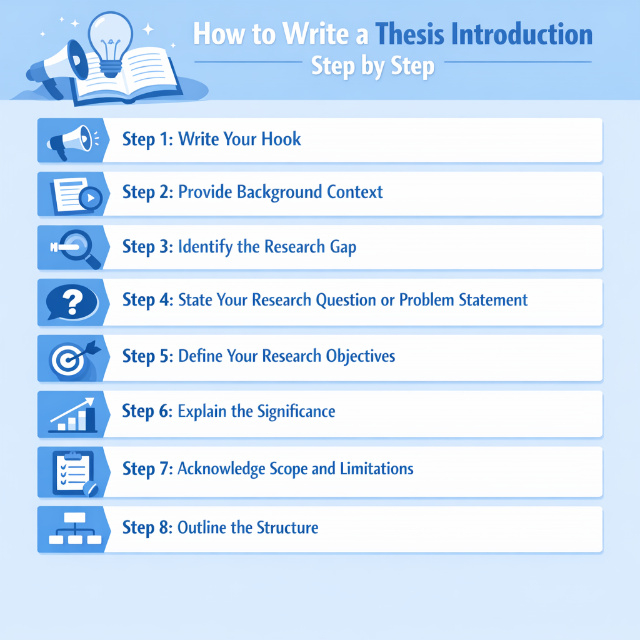
Step 1: Write Your Hook
Draft two or three possible opening sentences and pick the strongest. Good hooks reference a specific statistic, frame an unresolved tension in the field, or open with a concrete scenario your research addresses. Bad hooks start with dictionary definitions or grand historical sweeps.
Step 2: Provide Background Context
Use the funnel approach. Start with the broadest relevant context your reader needs, then narrow to the specific area your research occupies. You're not analyzing sources here, you're setting the scene. Keep external citations minimal; those belong in the literature review.
Step 3: Identify the Research Gap
Step 3 is about naming what's missing in the existing body of knowledge. What does current research not adequately explain, measure, or address? This transition, from background to gap, is where many students lose focus. Be direct: "Despite extensive research on X, little attention has been paid to Y in the context of Z."
Step 4: State Your Research Question or Problem Statement
One clear, specific statement. If your thesis addresses more than one question, list them, but keep them connected. Your research question is the pivot around which your entire thesis turns. If it's vague here, everything that follows will feel unfocused.
Step 5: Define Your Research Objectives
Two to four concrete objectives, written as active statements. These should map directly to your chapters. If an objective doesn't connect to a chapter, either the objective or the chapter needs rethinking.
Step 6: Explain the Significance
One focused paragraph. Be specific about who benefits (practitioners, policymakers, future researchers) and what the specific contribution is. Avoid generic academic language like "this will add to the body of literature."
Don't Have Time to Nail Your Intro? Our thesis writers handle the hard part so you don't have to. Join countless students who trusted MyPerfectWords.
Step 7: Acknowledge Scope and Limitations
Keep it brief and factual. State the geographical, demographic, or methodological boundaries of your study. Don't apologize for them, just name them clearly. This shows academic maturity.
Step 8: Outline the Structure
Walk your reader through the thesis chapter by chapter. Stick to one or two sentences per chapter. The goal is orientation, not summary.
Write your thesis introduction last, after you've completed the body chapters; it's much easier to introduce a thesis you've already written.
Remember that a thesis introduction is different from a dissertation introduction. To find out more about the differences between a thesis vs dissertation, check out our guide.
Thesis Introduction Examples by Degree Level
One of the most useful things you can do before writing your own introduction is to read strong examples at your degree level. Here are three annotated mini-examples showing what strong introductions look like at different stages of academic study.
Bachelor's Thesis Introduction (Excerpt)
"Rates of burnout among undergraduate nursing students in the UK have increased significantly over the past decade, yet most intervention programs remain designed for qualified practitioners rather than students in training. This study investigates the specific stressors associated with clinical placement in undergraduate nursing programs and evaluates the effectiveness of peer-support interventions in reducing burnout indicators."
What's working: The hook is specific and data-grounded. The research gap is named in the same breath as the context. The research question is clear before the reader has finished the second sentence. Bachelor's introductions work best when they focus on well-established knowledge and build toward a narrowly defined gap.
Master's Thesis Introduction (Excerpt)
"While the relationship between social media use and adolescent mental health has generated substantial research interest since 2015, the mechanisms by which different platform types affect self-reported wellbeing remain poorly understood. Existing studies frequently conflate passive consumption with active engagement, obscuring meaningful distinctions in the data. This thesis examines whether the type of social media interaction, passive versus active, predicts variations in well-being outcomes among 16-to 18-year-olds in secondary schools in Wales."
What's working: The gap is nuanced, not just "this hasn't been studied" but "this specific distinction has been missed." The problem statement is specific about population and geography. Master's introductions are expected to start identifying methodological or conceptual gaps, not just topical ones.
PhD Thesis Introduction (Excerpt)
"Postcolonial legal scholarship has examined how British colonial administrative law shaped governance structures in West Africa, yet the role of informal dispute resolution mechanisms in mediating between colonial and indigenous legal frameworks during the transition period of 1950–1970 remains largely undocumented. Drawing on archival sources across Ghana, Nigeria, and Sierra Leone, this thesis argues that informal mediation practices constituted a form of legal pluralism that shaped the trajectory of post-independence constitutional development in ways that formal legal histories have consistently underrepresented."
What's working: The gap is original and specific to the archival record. The thesis makes a claim; it "argues" something, rather than just investigating. PhD introductions stake original territory and signal the writer's unique contribution to knowledge.
A bachelor's introduction focuses on established knowledge; a master's introduction starts to identify gaps; a PhD introduction stakes original territory.
For full-length examples by discipline, see the PDF resources linked below.
What NOT to Include in Your Thesis Introduction
Most of the problems in weak thesis introductions come not from what's missing, but from what shouldn't be there. Here are the most common mistakes.
Writing a full literature review. Your introduction should reference key sources to establish context, not analyze them. Deep engagement with existing scholarship belongs in your dedicated literature review chapter. If you find yourself writing extended critiques of other researchers' methods, you've gone too far. Defining every term. Only define terms that are specific to your study and might be unfamiliar to a non-specialist reader. Terms that are standard in your field don't need defining. Over-defining reads as padding. Announcing what you're going to say instead of saying it. "In the next section, I will explain..." is weak academic writing. State your objectives and let the structure do the signposting. Your structural overview at the end of the introduction handles the roadmap. Starting with a clichéd quote or dictionary definition. Both are overused to the point of cliché and signal to examiners that the writer didn't know how to open strongly. Start with something specific to your research context. Burying the research problem. Your problem statement should be central and clear. If your reader has to hunt for it, your introduction isn't doing its job. It should be impossible to miss. Overstating your conclusions. Your introduction introduces your research; it doesn't deliver your results. Don't claim findings you haven't presented yet. Save your conclusions for the conclusion chapter. |
The single most common mistake in thesis introductions is writing too much about what other researchers found, which belongs in your literature review, not here.
Thesis Introduction Writing Tips
These are the practical habits that separate clean, readable introductions from the ones that get sent back for revision.
Write the introduction last. Or at minimum, revise it after completing your body chapters. You'll have a much clearer picture of what your thesis actually argues once you've written it. Many students draft a rough intro at the start, then rewrite it substantially once the thesis is complete.
Read three to five strong introductions in your field before you start. Look for theses that have been publicly praised or awarded in your department or institution. Notice how they balance context with problem statement, how specific they are, and how they handle the structural overview.
Match your tone to your discipline. Sciences and engineering tend toward formal, precise language with minimal narrative. Humanities disciplines often allow a more developed analytical voice in the introduction. Read what's expected in your field before you settle on a tone.
Get specific with your problem statement. If your problem statement could describe five other theses in your department, it's not specific enough. Name the population, geography, time period, or phenomenon precisely. Specificity signals clarity of thought.
For thesis format guidelines, margin requirements, heading styles, and citation formats, check the dedicated guide.
Once your introduction is drafted, run it through this checklist before handing it to your supervisor.
Introduction Writing Checklist
Check |
Hook: Specific, relevant, avoids clichés |
Background: Sets context without becoming a lit review |
Research gap: Clearly identified and specific |
Problem statement or research question: Central and precise |
Research objectives: 2–4, stated actively |
Significance: Concrete, names who benefits and how |
Scope and limitations: Acknowledged briefly |
Structural overview: One to two sentences per chapter |
No literature review content included |
No dictionary definitions as an opening |
Introduction is approximately 10% of total word count |
Primary keyword / core topic appears in the first paragraph |
Tone matches discipline conventions |
Ready to Get Your Thesis Introduction Done?
Work with a professional writer matched to your subject area.
- 100% original, human-written thesis introductions
- APA, MLA, Chicago, and Harvard formatting covered
- 3-hour rush delivery when you need it fast
- Money-back guarantee if you're not satisfied
No commitment until you're ready.
Place Your Order Today