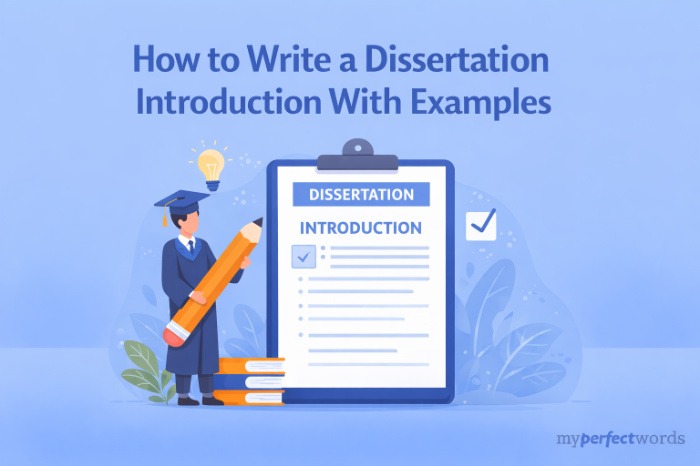
What Is a Dissertation Introduction?
The introduction is your dissertation's first chapter, not to be confused with the abstract, and definitely not the same thing as the literature review.
Your dissertation abstract is a short, standalone summary (usually 150–300 words) placed before the introduction.
It gives a bird's-eye view of the entire dissertation. The introduction is a full chapter. It provides context, builds the case for your research, and maps out the rest of the document.
The literature review, on the other hand, digs into existing research in your field. The introduction frames the problem, and the lit review examines what others have already said about it.
There's overlap, but they serve different purposes. If you want the full breakdown, our dissertation literature review guide covers that in detail.
Your dissertation introduction tells readers what you're studying, why it matters, and how you plan to answer it, before they read a single data point.
What to Include in a Dissertation Introduction
Most students either include too much (essentially rewriting the literature review) or too little (leaving the examiner with no sense of where the dissertation is going). Here's what actually belongs in the introduction chapter:
- Background context: Start broad and narrow down to your specific topic. Give readers enough context to understand why this area of study matters, without turning it into an essay in itself.
- The research problem or gap: What's missing from current knowledge? What question hasn't been answered well? This is the justification for your entire dissertation.
- Research question(s) and/or hypothesis: State this clearly. Don't hide it in dense academic language. Examiners want to see it plainly.
- Aims and objectives: Your aims are the broad goals. Your objectives are the specific steps you'll take to achieve them. Both belong here.
- Significance of the study: Why does this research matter? Who benefits from the answer? This is where you make the case for your work.
- Scope and limitations: Be upfront about what your dissertation covers and what it doesn't. This shows intellectual honesty, not weakness.
- Chapter overview/roadmap: Give readers a one-to-two-sentence summary of what each chapter covers. Think of it as a table of contents in prose form.
A strong dissertation introduction doesn't just describe your topic; it argues that the topic is worth studying.
Note: the exact combination of these elements varies by discipline and level. Humanities dissertations often blend some of them naturally. Science dissertations tend to separate them more rigidly. Always check your department's guidelines.
How to Write a Dissertation Introduction: Step-by-Step
Follow these steps in order. The writing will be smoother, the structure will be cleaner, and you'll end up with an intro that actually matches your finished work.
Step 1: Start With Background Context (Broad to Narrow)
Open with the wider topic and work your way toward your specific research area. Think of it as an inverted triangle, broad at the top, narrow at the point. Don't start with a dictionary definition. Start with why this field exists and why your corner of it matters.
Step 2: Identify the Research Gap or Problem
What's been overlooked, underexplored, or contradicted in existing research? This is your justification.
Be specific. "Not much research has been done" isn't enough; tell the reader exactly what's missing and why that matters.
Step 3: State Your Research Question Clearly
Your research question is the spine of the dissertation. Put it in plain language. If you can't state it in one or two sentences, you probably haven't fully defined it yet.
Step 4: Set out Your Aims and Objectives
Aims are general, objectives are specific. If your aim is to examine the impact of X on Y, your objectives might include: reviewing current literature, collecting data from the Z group, and analyzing results using a particular framework.
Step 5: Make the Case for Significance
Why should anyone care about your findings? Who does this research help: academics, practitioners, policymakers? Keep this section focused. Don't overclaim.
Step 6: Note Your Scope and Any Key Limitations
Be honest about boundaries. A master's dissertation can't solve everything. Acknowledging limitations shows you understand your research design.
Step 7: Write the Chapter Roadmap
End the introduction with a brief chapter-by-chapter overview. One to two sentences per chapter. This tells the examiner exactly how the dissertation is structured before they read it.
Most students rewrite their introduction after finishing their dissertation; that's not a mistake, it's the right process. Write a rough draft early to give yourself direction, then revisit and revise once you know what the dissertation actually does.
Once you've got the roadmap down on paper, you're ready to think about length.
How Long Should a Dissertation Introduction Be?
The general rule is 5–7% of your total word count. Here's what that looks like at different levels:
Level | Total Word Count | Intro Word Count |
Undergraduate | 8,000–12,000 | 400–840 |
Master's | 15,000–20,000 | 750–1,400 |
PhD | 70,000–100,000 | 3,500–7,000 |
These are guidelines, not rules. Different universities and departments have different expectations; always check your student handbook first. Some PhD programmes want a more expansive introduction that includes early theoretical framing; some undergrad dissertations are tightly structured and expect a shorter intro.
Your dissertation introduction should take up 5–7% of your total word count, enough to establish context and make your case, not a second literature review.
When Should You Write the Introduction?
The short answer: write a rough draft early, finalize it last.
Most students write the introduction first because it feels like the logical starting point. That's understandable. But your dissertation will change as you write it, your argument will tighten, your findings might shift your framing, and your chapter structure may evolve. If you lock in your introduction at the start, you'll almost certainly have to rewrite it at the end.
Write a rough version early to get your research question and aims on paper. Use your research proposal as a starting point; if you have one, it already contains the problem statement and research questions. Then, once you've finished your other chapters, come back and revise the introduction to accurately reflect what the dissertation actually does.
Don't Have Time to Write It Yourself? Get a professionally written dissertation introduction from a real academic writer. Countless students helped since 2010.
Dissertation Introduction Structure: An Example
Here's a brief annotated example showing how the elements map to real writing. This is a generic social science format; your discipline may structure things slightly differently.
Paragraph 1 is Background context: "Social media use among university students has grown substantially over the past decade, with platforms such as Instagram and TikTok now embedded in daily academic and social life. Research into the effects of this use on student wellbeing has grown in parallel, yet findings remain inconsistent and context-dependent."
[Sets the scene broadly, narrows to the specific area of interest.] |
Paragraph 2 is Research gap: "While existing studies focus largely on passive consumption, comparatively little attention has been given to how active content creation on social media platforms affects academic motivation and study behaviors."
[Identifies specifically what's missing from the literature.] |
Paragraph 3 is Research question and aims: "This dissertation asks: how does active social media participation affect the academic motivation of undergraduate students? Its aims are to review existing evidence, collect primary data from a sample of final-year students, and draw comparative conclusions across discipline groups."
[States the research question plainly, then sets out aims.] |
Paragraph 4 is Significance and scope: "Understanding this relationship has implications for student support services and digital wellbeing programmes. This study is limited to undergraduate students at a single UK institution and does not account for postgraduate populations or students with pre-existing anxiety diagnoses."
[Makes the case for significance, then acknowledges scope and limitations honestly.] |
Paragraph 5 is Chapter roadmap: "Chapter 2 reviews the existing literature on social media and academic outcomes. Chapter 3 outlines the research methodology. Chapter 4 presents findings from the survey data. Chapter 5 discusses these findings in relation to existing theory. Chapter 6 concludes with recommendations."
| [Clear, efficient, tells the examiner exactly what's coming.] |
The best way to understand the structure of a dissertation introduction is to read one annotated example, and then you can reverse-engineer your own.
Undergraduate intros will be shorter and may combine some of these elements. PhD introductions are more expansive and often include early theoretical positioning alongside the research gap.
Common Mistakes to Avoid in Your Dissertation Introduction
Mistake 1: Writing the Intro First and Never Revising It
If you write the intro at the start and don't touch it again, it probably won't match your finished dissertation. Always do a final revision once the rest of the work is done.
Mistake 2: Confusing the Introduction With the Literature Review
The introduction frames the problem. The dissertation literature review examines existing research in depth. These are separate chapters with different jobs. A common error is front-loading the introduction with so much discussion of existing research that it essentially doubles as a literature review.
Mistake 3: Being Too Vague About the Research Question
Broad topic language isn't enough. "This dissertation explores social media" tells the examiner nothing. A specific research question, one that can be clearly answered through your methodology, is what the introduction needs to deliver.
Mistake 4: Overstating Significance
It's tempting to make big claims about the importance of your research. But if your dissertation can't deliver on those claims, you'll be penalized in the viva or written feedback. Keep significance realistic and grounded.
Mistake 5: Forgetting the Chapter Roadmap
Some students end the introduction without a chapter overview, assuming the examiner will figure it out. Don't assume.
Our brief roadmap shows you a dissertation structure and gives the reader a clear map of what's ahead.
Free Downloadable Resources
Ready to Get Your Introduction Written?
Expert writers are standing by: place your order in minutes.
- Rated 4.8/5 from verified student reviews
- Any level: undergraduate, master's, or PhD
- Citation-style matched to your university requirements
- Confidential, plagiarism-free, and AI-detection safe
Order in minutes.
Place Your Order