What Is the Standard College Application Essay Format?
Here's the short answer before we go into any detail:
| Element | Standard Spec |
|---|---|
| Font | Times New Roman, Arial, or Calibri |
| Font Size | 12-point |
| Line Spacing | Double-spaced |
| Margins | 1 inch on all sides |
| Word Count | 250 to 650 words (Common App); 500 to 650 words ideal |
| Title | Optional |
| Heading | Not required for personal statement |
Most colleges don't hand you a formatting spec sheet. These are the accepted defaults that make your essay look professional and readable, whether it's reviewed on screen or printed out.
When in doubt, 12-point Times New Roman, double-spaced, with 1 inch margins is the safe choice for any college application essay.
Note that formatting specs apply when you're submitting a file upload. If you're submitting through the Common App text box (which is most students), the platform overrides some of your formatting anyway, more on that below.
College Application Essay Font, Spacing, and Margins: The Specs
Font
Stick to Times New Roman, Arial, or Calibri at 12-point. These are universally readable, don't carry any stylistic baggage, and render correctly across devices and printers. Anything else, Georgia, Garamond, Palatino, isn't wrong exactly, but it's an unnecessary variable. The goal is for the admissions officer to focus on your words, not your font choice.
| Avoid anything smaller than 11-point or larger than 12-point. Admissions readers go through hundreds of essays. Tiny fonts make reading harder. Bigger fonts look like you're trying to pad your word count. |
Spacing
Double-space your essay. This applies to the body text and any spaces between paragraphs. It's not just about aesthetics; double-spacing makes text easier to read quickly, and many readers annotate essays as they go.
| Don't use 1.5 spacing as a compromise. If you're submitting a Word doc or PDF, double-space it. If you're pasting into a text box, spacing becomes less relevant since the portal renders it differently. |
Margins
One inch on all sides. This is the Word and Google Docs default, so you probably don't need to change anything. Just don't shrink your margins to squeeze in more text, it's obvious and it signals that you're not working within the word count honestly.
Length
The Common App allows essays between 250 and 650 words. Most competitive applicants write 500–650 words. That's not a hard rule, but it signals that you've taken the prompt seriously. A 250-word essay for your main personal statement looks thin.
| Font size and spacing aren't cosmetic; they affect how readable your essay is and whether your ideas land the way you intended. |
Does a College Application Essay Need a Heading or Title?
This is where a lot of students get confused, so let's be specific.
Heading
refers to the block at the top of an academic paper, your name, the date, the course title, and the instructor's name. That's MLA or APA format for classroom assignments. You don't need this for a college personal statement. Adding an academic heading wastes words and makes your essay look like a term paper, not a personal statement.
Title
This is optional. If your essay has a theme that benefits from a title, something that acts as a frame for the reader, you can include one, centered at the top. No bold, no underline needed. But for most students, a title is just word count you're spending on something that doesn't help you.
The header
The running page header in Word is generally not needed for Common App submissions. If a specific school asks for one, for example, requesting your name and student ID in the header of an uploaded document, follow their instructions. Otherwise, leave it out.
Here's what the top of a correctly formatted essay looks like when a title is included:
The Space Between Seconds The summer I turned sixteen, I learned to watch my grandmother's hands... |
And here's what it looks like without a title (which is fine too):
| The summer I turned sixteen, I learned to watch my grandmother's hands... |
For most college application essays, you don't need a heading at all, and adding one can waste precious words.
Formatting Different Sections of a College Application Essay
The admissions counselor, while reading your essay, might base your test scores on the formatting. Here are the formatting rules and tips for different sections of your essay:
Page Headings
Most institutions follow a standard format for the application process. Here's how you can format your essay heading:
- Name: Your name should appear on the first line.
- Course Instructor/Supervisor: The second line should contain the name of your course instructor or supervisor.
- Title and Course Code: The third line should include the title of your essay, along with the course code.
- Submission Date: The last line should indicate the submission date.
Refer to the below example to get a comprehensive idea of the concept.
College Application Essay Title
The title of your college application paper is an important part of your essay. It gives your essay a professional look and helps organize it clearly.
Here are some important tips to keep in mind when creating your title:
- Centered Title: Your title should be centered at the top of the page, below the heading.
- Spacing: After typing the title, press the "Enter" key twice to begin your first paragraph.
- Include Key Details: If relevant, include your name, course title, and the submission date to make the paper appear formal.
- Professional Appearance: A well-structured title gives your essay a polished, professional look and makes it easier to read.
Here is an example to help you understand:
Name: Marry Allen Essay Title: By following these simple guidelines, your college application essay will have a clean, organized format that makes a strong first impression. |
You can use our blog on how to title an essay to get examples and tips from professionals.
Formatting the Introduction
The essay introduction sets the tone for your essay and hooks the reader. Think of it as the first impression you make; it has to count.
Format Tips:
- Keep it short: 4–5 sentences max.
- Start with a hook. It can be a vivid anecdote, a surprising fact, or a provocative question to grab attention.
- Have a thesis statement
- Avoid clichés like “Ever since I was a child…”
Example:
| "The stage lights blinded me, but in that moment, I wasn’t nervous—I was alive. Singing in front of my school was more than a performance; it was a declaration of who I was becoming. I had always been quiet, but that night, I found my voice in ways I hadn’t expected." |
Formatting the Body Paragraphs
The body paragraphs are the core of your essay, where you expand on your real-life experiences, provide evidence of your growth, and connect your experiences to your future goals.
Format Tips:
- Start each paragraph with a clear topic sentence.
- Provide examples to illustrate your points.
- Use transitions between paragraphs to maintain a smooth flow.
Example:
| "When my family moved to a small town, I thought my world had ended. The bustling city life I was used to seemed a lifetime away. But joining the debate team in high school wasn’t just a distraction, it became a platform where I learned to voice my opinions, challenge ideas, and embrace new perspectives. It wasn’t easy, but it taught me how to think critically and express myself confidently. The experience not only helped me adapt to my new environment but also sparked my passion for advocacy and social justice, a field I aim to explore in college." |
Formatting the Conclusion
The conclusion ties everything together and leaves a lasting impression on the reader.
Format Tips:
- Summarize your key message without repeating it verbatim.
- End with a reflective or forward-looking statement.
- Keep it concise (2–3 sentences).
Example:
| "This journey taught me that challenges aren’t barriers, they’re bridges to personal growth. As I take the next step toward college, I’m ready to continue building those bridges, tackling new challenges, and exploring new opportunities that will push me even further." |
Citation Style
Admission essays require specific citation styles, and the most commonly used and instructed styles include MLA, APA, Chicago, or Harvard. It's essential to follow these guidelines accurately to ensure your paper is properly cited and meets the required standards.
How to Structure a College Application Essay (Outline Template)
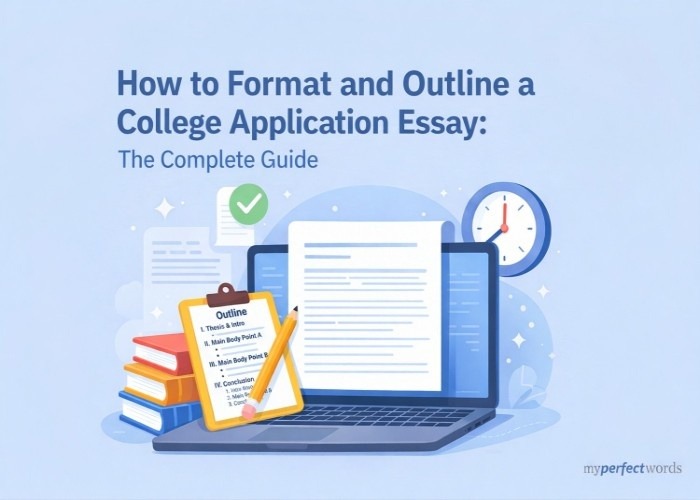
Structure and format are different things. Format is technical (font, spacing, margins). Structure is how you organize your ideas.
Here's the outline most strong college essays follow:
Intro (75 to 100 words)
- Open with a specific scene, moment, or detail, not a broad statement
- Establish what the essay is about without over-explaining
- Pull the reader in without summarizing everything upfront
Body Paragraphs (400 to 500 words, 3 to 5 paragraphs)
- Develop the story, idea, or experience
- Each paragraph should move the essay forward, not repeat what's already been said
- Include specific details: names, places, sensory details, dialogue if it fits
- One paragraph should contain your turning point or realization
Conclusion (75 to 100 words)
- Reflect on what this experience meant
- Connect it forward
- Who are you now because of it?
- Don't summarize what you just wrote. Add something.
Do you need exactly five paragraphs? No. The five-paragraph structure works fine, but it's not required. What matters is that your essay has a clear beginning, a turning point, and a reflection that only you could write.
| A strong college application essay doesn't need a specific number of paragraphs; it needs a clear beginning, a turning point, and a reflection that only you could write. |
For worked examples of this structure in action, see our college application essay examples.
Struggling to Write College Application Essay Yourself? Our writers handle formatting, structure, and voice, so you don't have to.
100% human-written essays, verified with Originality.ai
How to Format a College Application Essay for Submission
This is where most formatting problems actually happen, not in the writing, but in the submission.
Text Box Submission (Common App)
The Common App text box is a plain-text environment. When you paste from Word or Google Docs, here's what happens:
|
Here's how to submit without surprises:
|
| Before you hit submit, paste your essay into the Common App text box and use the Preview button; formatting that looked perfect in Word can break completely in the portal. |
File Upload
Some schools ask you to upload your essay as an attachment rather than pasting it. In that case:
|
For more on the Common App personal statement specifically, including prompts, tips, and what admissions officers actually look for, see our Common App essay guide.
College Application Essay Format Examples
Here are some common app college essay format examples for you to get a better idea:
What NOT to Do When Formatting a College Application Essay
A few things students do that immediately signal a lack of attention:
1. Don't use fancy fonts: Comic Sans, Papyrus, anything decorative, these aren't charming. They're distracting.
2. Don't add an academic heading to a personal statement: Your name, date, and instructor's name belong on a class paper. Not here.
3. Don't shrink your margins or font to fit more words: Admissions readers notice this. It reads as trying to cheat the word count.
4. Don't skip the portal preview: Submitting without checking the preview is the single easiest mistake to avoid, and one of the most common.
5. Don't include emojis, hashtags, or all-caps: Your essay should read like strong, clear prose. Not a text message or a social post.
6. Don't add a title just to have one: If a title doesn't add anything, it just costs you words. Most essays don't need them.
| Keep in mind that formatting requirements can differ for supplemental essays, which are often shorter and submitted in separate portals with their own rules. |
To sum up,
Formatting your college application essay correctly is crucial. It's not just about your experiences and achievements; it's about how you present them.
A well-structured and properly formatted essay can make a significant difference in your application's success.
Ready to Get Your Essay Done?
We've helped 50,000+ students write college essays that actually get read.
- Expert writers who know what admissions officers want
- Zero AI content, guaranteed clean on every detector
- Rush options for tight deadlines
- Revisions included until you're completely satisfied
Your essay. Done right. On time.
Get College Essay Help
-20643.jpg)