Why Persuasive Essay Examples Help You Write Better
Reading examples is one of the fastest ways to improve your persuasive writing. You're not guessing at structure or technique. You can see exactly how someone made an argument work.
Here's what you pick up from studying examples: how to position a thesis, how to weave evidence into a paragraph without it feeling forced, how to acknowledge the other side without giving up ground, and how to end with something that actually sticks. That's hard to get from a how-to guide alone.
What the best examples teach you:
- How to open with a hook that earns attention (not just a vague question)
- How to use ethos, pathos, and logos in a single essay without overdoing any one
- How transitions move a reader from one point to the next without announcing themselves
- What a thesis that's actually debatable sounds like vs. a weak one
- How much evidence is enough per paragraph
How to use this collection:
Read examples at your grade level first. Then read the "What Makes It Effective" section after each one before you jump to the next. The analysis is where the learning happens.
Persuasive Essay Examples For Students
A persuasive essay aims to convince the reader of the author’s point of view.
To find the right path for your essay, it's helpful to go through some examples. Similarly, good essay examples also help to avoid any potential pitfalls and offer clear information to the readers to adopt.
Let’s take a look at 2 short persuasive essay examples, focusing on current and relevant issues:
Example 1:
Why Napping Should Be Encouraged in Schools? Ever feel like your brain is fried after lunch? You're not alone! Many students experience an afternoon slump, making it hard to focus and learn. But what if there was a simple solution: naps? Napping isn't just for babies. Studies show that short naps can boost alertness, improve memory, and enhance creativity. Imagine feeling refreshed and ready to tackle those afternoon math problems or history readings. Schools should encourage napping by providing designated quiet spaces and flexible schedules. Some might argue that naps cut into valuable learning time. However, research suggests that napping can actually lead to better overall learning. A well-rested student is more likely to pay attention, absorb information, and participate actively in class. It's a win-win situation! Schools around the world are already experimenting with nap programs, and the results are promising. Students report feeling more energized and focused, and their academic performance is improving. Wouldn't it be great if your school joined this trend? Let's ditch the afternoon slump and embrace the power of napping. It's a simple change that can have a big impact on student learning and well-being. |
Example 2:
The Power of Play in Education Introduction: Have you ever noticed how children seem to learn best when they're having fun? Imagine classrooms transformed from rows of desks and textbooks into vibrant spaces filled with laughter and exploration [Sensory Details]. This engaging environment can be achieved by incorporating more play-based learning into the curriculum. Play is not just a frivolous activity; it's a powerful tool that should be used throughout a student's academic journey [Direct Approach]. This essay argues that play-based learning fosters creativity, problem-solving skills, and a lifelong love of learning [Thesis Statement]. Body Paragraphs: Beyond simple entertainment, play offers a dynamic learning experience. Through games, simulations, and hands-on activities, students actively engage with concepts [Logical Reasoning]. They experiment with different approaches, analyze situations, and learn from their mistakes. This active learning environment sparks curiosity, a natural human desire to explore further, and ultimately leads to a deeper understanding of the subject matter [Sensory Details]. Play also cultivates critical thinking and problem-solving skills, essential for success not only in academics but also in future careers and everyday life [Logical Reasoning]. Whether it's building a block tower or collaborating on a play, children develop crucial skills like analyzing situations, making decisions, and working together to overcome challenges [Addressing Concerns]. Some might argue that play is a distraction from serious learning. However, research shows the opposite is true, play-based learning actually increases student engagement and academic achievement [Addressing Concerns]. Students who learn through play are more motivated, retain information better, and develop a love of learning that extends beyond the classroom walls [Logical Reasoning]. Conclusion: In conclusion, incorporating play-based learning into education offers a wealth of benefits for students. It ignites curiosity, fosters critical thinking skills, and promotes a lifelong love of learning [Reiteration]. Let's encourage our schools to embrace play as a powerful tool and create classrooms filled with laughter, exploration, and a deeper understanding for every student [Call to Action]. |
Short Persuasive Essay Examples (For Quick Learning)
Short examples are often the best starting point. They're complete arguments in 150 to 200 words, so you can see the full structure at a glance before tackling longer essays.
Example 1: Social Media Age Limits
Should social media platforms require users to be 16 or older? Social media companies have known for years that their platforms can harm teenagers, yet they've done little to stop underage use. That needs to change. Platforms should be legally required to verify that users are at least 16 before allowing account creation. The evidence is clear. A 2023 study published in JAMA Pediatrics found that adolescents who spent more than three hours per day on social media were significantly more likely to report symptoms of anxiety and depression. Instagram's own internal research, revealed during U.S. Senate hearings, showed the platform made body image issues worse for one in three teenage girls. Some argue that age restrictions are unenforceable. But that argument applies to many laws we still uphold. We don't abandon drunk driving laws because some people break them. We enforce them because the harm is real. Protecting teenagers from documented harm is not censorship. It's a basic responsibility. |
What Makes It Effective:
|
Example 2: School Start Times
Should high schools start later in the morning? Most high schools start before 8 a.m. Most teenagers can't fall asleep before 11 p.m. These two facts are the entire problem. The American Academy of Sleep Medicine recommends that teenagers get eight to ten hours of sleep each night. Starting school at 7:30 a.m. makes that mathematically impossible for most students. The result is chronic sleep deprivation that affects academic performance, mental health, and even driving safety. When Fairfax County, Virginia pushed high school start times back by 50 minutes, attendance improved, car crash rates dropped, and students reported lower levels of depression. The data wasn't close. Critics say later starts complicate after-school activities and working parents' schedules. These are real concerns worth addressing through flexible scheduling. They are not reasons to keep thousands of students sleep-deprived year after year. The evidence has been in for decades. The only thing missing is action. |
What Makes It Effective:
|
Example 3: Sustainable Fashion
Why students should support sustainable fashion brands Fast fashion produces 10% of global carbon emissions annually and generates 92 million tons of textile waste each year. If the clothing industry were a country, it would be the third largest polluter on earth. Students have more power over this than they think. Buying from sustainable brands or secondhand shops reduces demand for fast fashion directly. It's not symbolic. Every dollar redirected away from brands that dump dye runoff into rivers is a dollar not funding that practice. The objection that sustainable clothing costs more is mostly a myth at this point. Thrift stores, clothing swaps, and brands like Patagonia, Everlane, and Tentree compete on price more than they used to. And buying less, better quality clothing costs less in the long run than replacing cheap items every few months. Students control billions of dollars in consumer spending. Using that power consciously is one of the most direct forms of environmental action available to us. |
What Makes It Effective:
|
Persuasive Paragraph Examples
Before writing full essays, it helps to master persuasion in a single paragraph. These examples show complete arguments in 4-6 sentences.
Element | School Uniforms Example | Homework Limits Example |
Topic Sentence | Schools should require uniforms to reduce socioeconomic divisions among students. | Schools should limit homework to 90 minutes per night to protect student wellbeing. |
Evidence 1 | A 2019 study in Psychology of Education found that uniform policies reduced visible wealth disparities and improved peer relationships. | Research from Stanford University found that more than 90 minutes of homework per night was associated with higher stress and lower academic engagement. |
Evidence 2 | When students aren't competing on brand names, social hierarchies based on clothing spend down. | When students are overloaded, they're more likely to cut corners or disengage entirely. |
Concluding Sentence | Uniforms don't erase inequality, but they remove one visible daily reminder of it. | The goal of homework is reinforcement, not exhaustion. |
Complete Paragraph Example 1: Classroom Tech Integration
| Schools that restrict student access to laptops and tablets are preparing students for a world that no longer exists. Every professional environment in 2026 requires digital literacy, from spreadsheet navigation to collaborative cloud tools. The argument that screens are distracting ignores the fact that distraction management is itself a skill students need to develop. Teaching students to use technology responsibly is not optional anymore. It's a core competency. |
What Works:
| The topic sentence states a provocative position. Evidence references real-world relevance rather than test scores alone. Counterargument addressed in sentence three. Closing reframes the debate around necessity. |
Complete Paragraph Example 2: Student Mental Health Support
| Schools that invest in counselors, not just test prep, produce graduates who are both healthier and more academically successful. The American School Counselor Association recommends one counselor per 250 students. The national average is one per 408. That gap has consequences. Students dealing with anxiety, family stress, or social difficulties without support don't suddenly perform better under academic pressure. They fall behind and burn out. Funding counselors isn't a soft priority. It's infrastructure. |
What Works:
| Opens with a dual benefit claim (healthy AND successful). Uses specific numbers to show the gap. Closes with a reframe that makes the ask feel essential, not optional. |
Struggling With Your Persuasive Essay?
Let our professional writers handle it while you focus on other priorities.
Join 50,000+ students who trusted us with their essays.
Persuasive Essay Component Examples
Understanding how each part of an essay works helps you build stronger ones. Here are annotated examples of introductions, body paragraphs, and conclusions.
Persuasive Essay Introduction Examples
Introduction 1: Question Hook
| Should a woman have the legal right to make decisions about her own body, or should the government make those decisions for her? The debate around abortion in the United States has divided communities for decades, but at its core, the question is simple: who holds authority over personal medical decisions? Access to safe, legal abortion is a constitutional right that should remain protected, not because everyone agrees on the ethics, but because the alternative puts lives at risk and government authority where it doesn't belong. |
Analysis:
|
Introduction 2: Statistic Hook
| Every year, more than 3,500 students in the United States drop out of high school because of financial pressure. Most of them want to stay. A single policy change could keep thousands of them enrolled: eliminating school lunch debt. When a student is sent to the office over an unpaid $2.50 lunch account, the school isn't just denying them food. It's signaling that their financial situation is a behavioral problem. Schools should eliminate lunch debt entirely and fund meals through district budgets, not shaming policies. |
Analysis:
|
Introduction 3: Anecdote Hook
| When Maya was a junior in high school, she stopped raising her hand in class. Not because she didn't know the answers. Because she'd been told her accent made her hard to understand. Stories like hers aren't rare. ESL students across the country are pushed into remedial tracks not because of ability gaps but because of language bias embedded in how schools measure intelligence. Schools should restructure ESL programs to accelerate academic integration rather than separate students from their peers. |
Analysis:
|
Persuasive Essay Body Paragraph Examples
Body Paragraph 1: Research Heavy
| Ethical business practices are not a cost to companies. They're an investment with measurable returns. Patagonia's decision to donate 1% of revenue to environmental causes built a brand so loyal that customers camp outside stores for product releases. Costco's above-average employee wages result in turnover rates roughly a third of the retail industry average, saving the company hundreds of millions in training costs annually. A 2019 Harvard Business Review analysis of 200 companies found that those with strong corporate social responsibility outperformed industry peers on total shareholder return over ten years. The notion that doing good costs too much ignores a decade of data showing the opposite. |
Analysis:
|
Body Paragraph 2: Counterargument Paragraph
| Critics of mandatory voting laws argue that forcing citizens to vote violates their freedom of expression. This objection sounds principled, but it misunderstands what freedom means in a civic context. We already compel citizens to serve on juries, file tax returns, and register with the Selective Service. None of these obligations is considered a violation of freedom because they are understood as requirements of participation in a functioning society. Voting is no different. Countries with compulsory voting, like Australia and Belgium, consistently report higher civic satisfaction and lower political polarization than countries without it. The evidence suggests that mandatory participation doesn't threaten democracy. It strengthens it. |
Analysis:
|
Body Paragraph 3: Emotional Appeal
| Behind the statistics on student loan debt are real people making impossible choices. Parents refinancing homes to cover tuition. Students graduating into careers they hate because they needed the salary to service debt, not the work. Young adults delaying children, homeownership, and stability because the debt load from four years of college follows them through their thirties. These aren't edge cases. According to the Federal Reserve, 45 million Americans hold student loan debt with an average balance of $38,000. That's not a personal finance problem. That's a structural failure that warrants a structural solution. |
Analysis:
|
Persuasive Essay Conclusion Examples
Conclusion 1: Call to Action
| The data on gun violence in the United States is not ambiguous. More guns, less regulation, and more deaths. Countries with stricter laws have a fraction of the casualty rates. The argument that nothing can be done has been tested and found false in every nation that chose to test it. What remains is the question of will. Universal background checks are supported by more than 90% of Americans across party lines, according to Gallup. That consensus exists. Congress has the authority to act on it. The next time a bill reaches the floor, contact your representative and make your position clear. Laws change when enough citizens demand it. That threshold has already been crossed. |
Analysis:
|
Conclusion 2: Forward Looking
| Artificial intelligence will handle most routine cognitive tasks within a generation. That's not a prediction anymore. It's a planning assumption. The question is whether the education system students graduate from today prepares them for that world or the one that already passed. Schools that invest in critical thinking, creative problem-solving, and adaptive learning now are building human skills that AI cannot replicate. The students who will thrive aren't the ones who memorized the most facts. They're the ones who learned how to think when the facts kept changing. |
Analysis:
|
Persuasive Essay Examples by Grade Level
The right level of complexity matters. Here are examples calibrated for each academic stage.
Persuasive Example For Elementary Schools
Here are some sample essays to further explain the concept of persuasive writing for students.
Persuasive Essay Examples Middle School
Check out these persuasive essay examples for middle school to get a comprehensive idea of the format structure.
Persuasive Essay Examples High School
The following are good persuasive essay examples for high school. Having a look at them will help you understand better.
Persuasive Essay Examples for College Students
Essay writing at the college level becomes more complicated. We have provided you with top-notch college persuasive and argumentative essay examples here. Read them to understand the essay writing process easily.
Persuasive Essay Examples For University
It becomes even more challenging to draft a perfect essay at the university level. Look at the examples of persuasive essays below to get an idea of writing one.
Persuasive Essay Examples by Format
3 Paragraph Persuasive Essay Example
Topic: Reduce Single-Use Plastics Format: Intro + Argument, Counterargument + Conclusion Paragraph 1 (Introduction + Thesis): Eight million metric tons of plastic enter the world's oceans every year. That's roughly the equivalent of a garbage truck dumping its load into the ocean every minute of every day. Governments must implement aggressive restrictions on single-use plastics, including bans on plastic bags, straws, and packaging, backed by financial penalties for non-compliance. Paragraph 2 (Main Argument + Counterargument): The case for restriction is practical, not just environmental. Single-use plastics that end up in oceans break into microplastics, which enter the food chain, accumulate in fish, and ultimately in the humans who eat them. A 2021 study found microplastics in human blood samples for the first time, a direct health concern that extends the issue beyond environmental activism. Critics argue that plastic restrictions harm low-income consumers who rely on cheap packaging. This concern is legitimate but addressable. Chile, Kenya, and Canada have all implemented effective plastic restrictions with exemptions and subsidy programs that protect affordability for lower-income households. Paragraph 3 (Conclusion): The health and environmental evidence for restricting single-use plastics is no longer contested. The practical objections have working solutions in countries that have already implemented them. What's needed is political will and a timeline with enforcement teeth. The ocean does not wait for legislative consensus. |
When to Use This Format:
|
5 Paragraph Persuasive Essay Example
Topic: Mandatory Community Service for High School Students Paragraph 1: Introduction: More than half of American high school graduates report feeling unprepared for adult civic life. They know how to take tests. They don't know how to show up for someone other than themselves. Mandatory community service requirements for high school graduation would address this gap by building civic habits before students leave the one institution designed to shape them. Paragraph 2: First Argument: Community service develops skills that no classroom subject covers effectively: empathy, adaptability, and the experience of contributing to something larger than one's own interests. A 2018 meta-analysis in the Journal of Youth and Adolescence found that students who completed structured service-learning programs showed measurable improvements in civic knowledge, social responsibility, and long-term volunteer behavior. The habits built during formative years persist. Building civic habits at 16 is more effective than hoping they develop spontaneously at 25. Paragraph 3: Second Argument: The practical benefits extend beyond individual development. Communities with higher rates of volunteer participation have stronger social cohesion, lower rates of civic disengagement, and better outcomes in public health, education, and crisis response (National Commission on Military, National, and Public Service, 2020). A graduating class of 500 students completing 40 hours each represents 20,000 hours of community labor. That's not symbolic. That's meaningful infrastructure support for nonprofits, libraries, food banks, and tutoring programs that are chronically understaffed. Paragraph 4: Counterargument: Opponents of mandatory service argue that forced volunteerism contradicts the spirit of volunteering itself, and that students will complete requirements resentfully rather than meaningfully. These are fair concerns. But research consistently shows that exposure leads to internalization. Students who begin service reluctantly and complete it frequently report attitude shifts. The longitudinal data show higher rates of ongoing volunteerism among students who were required to serve in school than among those who were not (Corporation for National and Community Service, 2019). Resentment often converts to purpose when the work is real. Paragraph 5: Conclusion: The purpose of high school education is not only to produce skilled workers. It's to produce citizens. Mandatory community service requirements recognize that civic engagement is a skill that must be taught, practiced, and reinforced like any other. The data support it. The communities that need support support it. The question is whether high schools are willing to treat civic identity as part of their mandate. |
When to Use This Format:
|
Notice how the examples are clearly organized and logically structured. If you want to achieve the same clarity, explore our persuasive essay outline guide.
How to Analyze Persuasive Essay Examples (Study Guide)
Reading examples passively helps. Analyzing them actively teaches you to write. Use this framework on any persuasive essay, including the ones above.
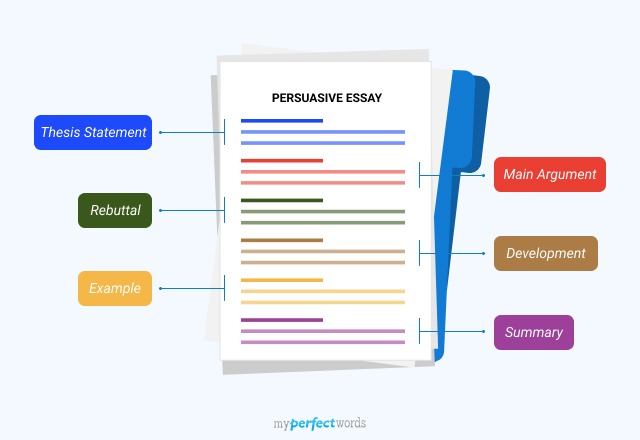
Step 1: Find the Thesis. Where does it appear? Is it specific and debatable? Does it commit to a position or stay vague?
Step 2: Map the Evidence. What types does the writer use? Statistics, expert opinions, case studies, anecdotes, logical reasoning? How is evidence introduced, not just dropped in?
Step 3: Trace the Structure. How many paragraphs? What does each one accomplish? How do they build on each other?
Step 4: Spot the Techniques. Where does ethos (credibility) appear? Where does pathos (emotion) appear? Where does logos (logic) appear? Does any section overuse one at the expense of the others?
Step 5: Evaluate the Counterargument. Does the essay acknowledge the opposing view? Does it address it specifically or just gesture at it? Does the rebuttal strengthen the main argument or just dismiss the opposition?
Step 6: Study the Conclusion. How is the thesis restated without repeating it word for word? Is there a clear call to action? Does the final sentence land or just stop?
Practice: Pick one of the high school examples above. Work through all six steps before reading the analysis. Then compare your observations to what's written. The difference between what you noticed and what you missed is your next area to work on.
Common Mistakes to Avoid (With Before/After Examples)
Mistake 1: Weak Thesis
Weak: "Pollution is a serious problem, and everyone should care about it." Strong: "Cities should ban single-use plastics and levy fines on commercial packaging waste by 2028 to cut municipal ocean pollution by 40%."
| Why the strong version works: Specific. Actionable. Has a measurable target and a deadline. Impossible to agree with without thinking about it. |
Mistake 2: Opinions Without Evidence
Weak: "Social media is clearly damaging to teenagers. You can see it everywhere."
Strong: "A 2023 study in JAMA Pediatrics found that adolescents spending more than three hours daily on social media were significantly more likely to report anxiety and depression."
| Why the strong version works: "You can see it everywhere" proves nothing. Named research with a specific finding proves something. |
Mistake 3: Ignoring the Counterargument
Weak: [Essay arguing for school uniforms that never mentions that uniforms can suppress individual expression]
Strong: [Same essay that acknowledges "Critics argue uniforms suppress individuality, which is a real value" and then argues that the documented reduction in visible economic disparity is a stronger competing value]
| Why the strong version works: Readers who disagree with you have objections. Addressing them shows you've thought through your position. Ignoring them looks like you haven't. |
Mistake 4: Weak Conclusion
Weak: "In conclusion, this is why I think social media should be regulated. These are the reasons I have discussed."
Strong: "The research is there. The policy models from other countries are there. What's left is deciding whether the political cost of regulation is higher than the human cost of doing nothing."
| Why the strong version works: The weak version summarizes. The strong version reframes the stakes and ends on a note of tension that makes the reader think. |
Conclusion


-20427.jpg)