Why Editing in the Right Order Matters
Most students edit randomly, fixing a comma while the argument underneath it is broken. If you polish a paragraph's sentences and then realize the whole paragraph needs to be cut, you've wasted that time.
The right order is: Structure and Argument first, then Clarity and Style, then Surface Errors. That's exactly how the tips below are organized.
"Fixing typos before fixing your argument is like painting a house before checking if the foundation is solid." |
Tier 1: Structure and Argument
Tip 1: Check Your Thesis Does What It Promises
A weak thesis is the most common reason an essay falls flat, and it's one of the hardest problems to spot when you've been working on the same draft for hours.
Re-read your thesis. Is it specific? Is it debatable? Now read each body paragraph's topic sentence. Does every paragraph connect back to that thesis? If a topic sentence doesn't line up, you either need to fix the paragraph or revise the thesis.
Before: "Social media affects teenagers." After: "Social media platforms designed for passive scrolling correlate with higher rates of anxiety in teenagers because they prioritize engagement over emotional wellbeing." |
The second version makes a claim you can actually argue. The first one just states a fact.
Tip 2: Test Your Structure by Reading Topic Sentences Only
Here's a fast structural audit that most students skip: read your introduction, then skip to just the first sentence of each body paragraph. Nothing else, just those opening sentences.
Does your essay still make logical sense? Do the points follow each other in a way that builds an argument? If the logic breaks down, your structure needs work before anything else.
"If your topic sentences alone don't tell a coherent story, your essay's structure needs work." |
Tip 3: Cut What Doesn't Earn Its Place
Every paragraph should do one clear job. If you can't state that job in a single sentence, the paragraph is probably bloated, off-topic, or doing two things at once.
This is where students resist. You spent time on that paragraph, and it feels like cutting it wastes the effort. Flip that thinking: submitting a tight, focused essay earns you more than padding it to look thorough.
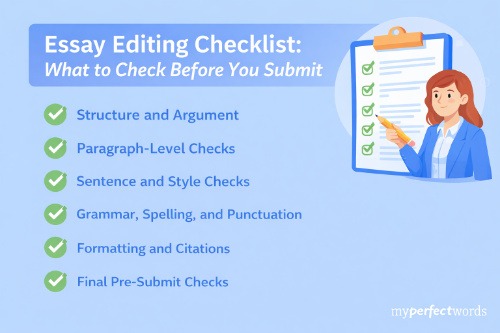
Check our essay editing checklist if you want a structured way to flag sections that aren't pulling their weight.
Tip 4: Read Each Body Paragraph Against Your Intro
Here's one that teachers use and students almost never do: copy and paste your introduction above each body paragraph, one at a time. Then read the intro followed immediately by that paragraph.
Ask yourself: does this paragraph deliver on what the intro promised? Students who go off-topic usually do it gradually, by the third or fourth paragraph they're somewhere the intro never pointed. This test catches that immediately.
Tier 2: Clarity and Style
Tip 5: Cut Unnecessary Words
Unnecessary words are everywhere in first drafts. Words like "very," "really," "quite," and phrases like "in order to" or "due to the fact that" add length without adding meaning.
Before: "Due to the fact that the experiment was conducted in a very controlled environment, the results are quite reliable." After: "Because the experiment was conducted in a controlled environment, the results are reliable." |
"The fastest way to improve your writing isn't adding better words. It's removing the bad ones."
Not Sure Your Essay Is Ready to Submit? Let a professional editor review it before it's too late. Countless students helped since 2010. Your deadline is safe with us.
Tip 6: Vary Your Sentence Lengths
If every sentence in a paragraph runs 20-plus words, the essay feels exhausting to read. Mix short, punchy sentences with longer ones. The contrast creates rhythm and keeps a reader engaged.
Flat version: "The policy change affected many communities across the country. It led to significant financial consequences for local governments. The outcome was not what officials had anticipated." With variation: "The policy change affected communities across the country. Local governments faced costs no one had planned for. It didn't go the way officials expected." |
Watch your passive voice too. "Mistakes were made" is weaker than "Officials made mistakes." Active construction is almost always cleaner.
Tip 7: Read Your Essay Aloud
This is the one tip that sounds obvious but that most students skip. Actually read your essay out loud, not in your head.
When you read silently, your brain autocorrects errors. It fills in what you meant to write, not what's actually there. Reading aloud forces you to process every word. You'll hear run-on sentences, awkward transitions, and clunky phrasing that you'd never catch on a screen. Research on reading aloud consistently shows it catches errors that silent review misses.
A practical rule: if you stumble reading it aloud, a professor will stumble reading it too.
Tier 3: Surface Errors
Tip 8: Take a Break Before You Proofread
Your brain is terrible at catching errors in something you just wrote. It already knows what you meant to say, so it reads what it expects rather than what's there. This is called familiarity blindness.
Even a one-hour break before proofreading resets your perspective enough to catch errors you'd otherwise skip. Overnight is better. The UNC Writing Center covers this well in their guide to editing and proofreading.
If you're doing a full proofreading pass rather than quick surface corrections, see our guide on how to proofread an essay for a complete walkthrough.
Tip 9: Print It Out (or Reformat the Screen Version)
Errors that hide on a screen appear on paper. Something about the change in format, the physical page, the different font rendering, breaks the familiarity you've built up with your draft.
If printing isn't an option, change the font and size on your screen before your final read. It creates enough visual distance to work almost as well. If you do print, try using different pen colors for different error types: one color for grammar, another for punctuation, another for unclear phrasing. It keeps your corrections organized.
Tip 10: Don't Trust Spellcheck Alone
Spellcheck is a starting point, not a finish line. It won't flag homophones like "their" and "there," "form" and "from," or "affect" and "effect." These are among the most common errors in student essays and they sail right past automated checkers.
Grammarly catches more than basic spellcheck, but it also makes contextual mistakes. Use it as a supplement, not a replacement for reading carefully yourself.
When These Tips Aren't Enough
Self-editing has real limits. The closer you are to a draft, the harder it is to see what's actually on the page versus what you meant to write. For a standard assignment, these 10 tips will get you there.
For high-stakes work, a tight deadline, or an essay you've been staring at for too long, a professional editor catches things you won't. Not because you're a bad writer, but because fresh eyes always see more.
If you're wondering about how long does essay editing take, that depends on the service, the scope, and whether you need a rush turnaround.
Your Essay Deserves Expert Eyes
Send it to a professional editor and get it back polished and ready to submit.
- Human editors who've reviewed thousands of student essays
- Rush turnaround available, even 3-hour delivery
- Plagiarism-free
- Turnitin-verified every time
Trusted by students since 2010. Order in under 2 minutes.
Place Your Order