What is an Expository Essay?
An expository essay is a type of essay that aims to inform, describe, or explain a particular subject using facts, examples, and logical reasoning. The focus is on presenting information objectively rather than sharing personal opinions or trying to persuade readers.
Think of expository writing as teaching your reader about something. You're not arguing a position or telling a story. You're explaining how something works, what something means, or why something happens.
Key Characteristics of Expository Essays
| Characteristic | Description |
|---|---|
| Objective | Facts over opinions |
| Evidence-based | Uses research, examples, and data |
| Clear structure | Introduction, body, conclusion |
| Informative | Teaches the reader |
| Neutral tone | No persuasion or bias |
What Makes Expository Essays Different
Expository essays differ from other essay types in important ways. Argumentative essays try to convince you to accept a specific viewpoint using evidence and reasoning. Narrative essays tell a story about personal experiences or events. Expository essays simply explain and inform without taking sides or sharing personal stories.
Why You Write Expository Essays
Schools assign expository essays for several good reasons. They help you develop research skills by finding and evaluating credible sources. They build critical thinking as you organize complex information logically. They teach you to write clearly and objectively, which are valuable skills in almost any career.
Types of Expository Essay
Expository essays come in several forms, each designed for different explanatory purposes.
| Type | Purpose | Example Topic |
|---|---|---|
| Descriptive Essay | Describe in detail | "The Grand Canyon" |
| Process Analysis Essay | Explain how-to | "How to bake bread." |
| Compare and Contrast Essay | Show similarities/differences | "Public vs. private school." |
| Cause and Effect Essay | Explain why/results | "Effects of social media" |
| Problem and Solution Essay | Identify issue + solutions | "Reducing plastic waste." |
| Classification Essay | Categorize into groups | "Types of renewable energy" |
For detailed information on each type with additional examples, check out our guide on types of expository writing.
EXPERT WRITING HELP
Need Help With Your Expository Essay?
Our expert writers can handle any expository essay type with ease.
Structural Layout of an Expository Essay
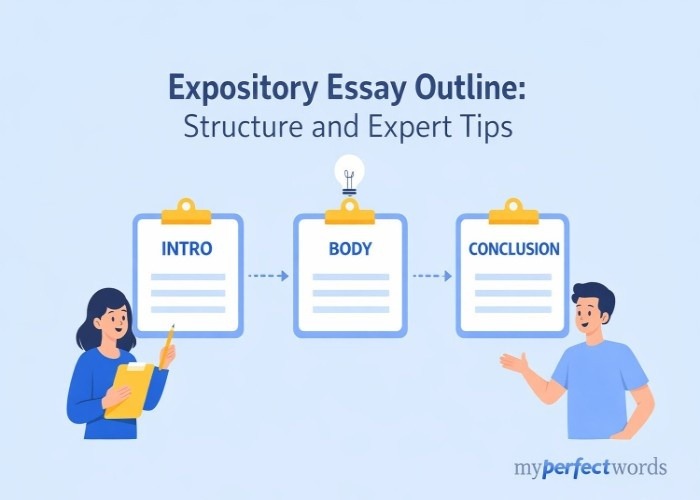
Every expository essay follows a three-part structure that provides logical flow.
The Three Main Parts:
Your essay has an introduction that sets up your topic, body paragraphs that develop your main points, and a conclusion that wraps everything up. Each part serves a specific purpose and contains key elements.
Introduction:
The introduction grabs your reader's attention and provides essential context. Start with a hook, an interesting fact, a relevant question, or a surprising statistic that draws readers in.
Give enough background information so readers understand your topic. End with a clear thesis statement that outlines what you'll explain in your essay.
Body Paragraphs:
Body paragraphs develop your main ideas with evidence and examples. Each paragraph should focus on one main point. Start with a topic sentence that introduces the paragraph's focus.
Support your point with evidence from research, examples, or data. Explain how the evidence supports your point. Use transitions to connect paragraphs smoothly. Most expository essays have three to five body paragraphs.
Conclusion:
The conclusion brings your essay to a satisfying close. Restate your thesis in different words. Summarize your main points briefly. Provide closing thoughts or discuss broader implications of your topic. Don't introduce new information here.
Visual Structure Breakdown:
| Section | Purpose | Key Elements |
|---|---|---|
| Introduction | Set the stage | Hook, background, thesis |
| Body | Develop ideas | Topic sentences, evidence, analysis |
| Conclusion | Wrap up | Restate thesis, summarize, close |
For templates and detailed structure guidance, see our expository essay outline guide.
How to Write an Expository Essay
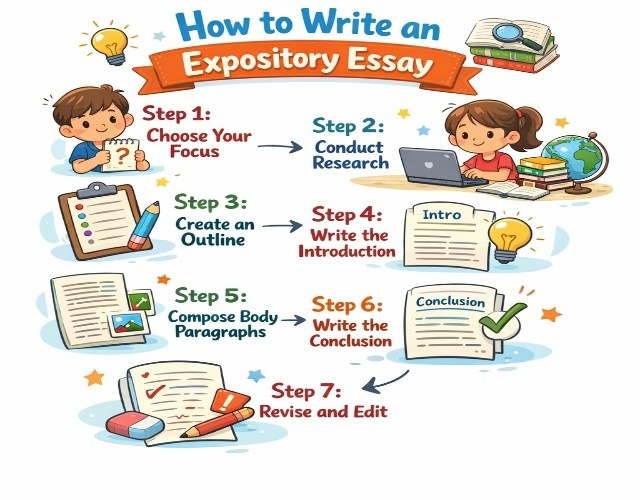
Writing an expository essay follows a systematic process. Follow these steps for success.
Step 1: Choose Your Focus
Choose an interesting topic that you can explain with facts and research. The topic should be manageable, not too broad or too narrow for your assignment length. Make sure adequate research materials are available on your subject. Your topic must be informational rather than argumentative or opinion-based.
Consider topics that genuinely interest you. If you're engaged with the subject, your writing will be more compelling. Ensure the topic fits your assignment requirements and can be covered thoroughly in the required length.
Need help getting started? Explore our expository essay topics list.
Step 2: Conduct Research
Explore credible sources to gather information about your topic. Use books, scholarly articles, and reputable websites from .edu or .org domains.
Take detailed notes and keep track of your sources for citations. Look for diverse perspectives to provide balanced coverage. Verify author credentials and publication dates to ensure reliable information.
Step 3: Create an Outline
Organize your thoughts logically before writing. Map out your introduction, body paragraphs, and conclusion. List main points for each section and arrange supporting evidence under relevant headings. A good outline ensures coherent flow and saves time during drafting.
Check our detailed guide on creating an expository essay outline for a well structured expository essay!
Step 4: Write the Introduction
Start with an engaging hook, an interesting fact, a relevant question, or a surprising statistic. Provide necessary background information to contextualize your topic. End with a clear thesis statement outlining the main points you'll cover. Keep your introduction concise and focused.
Step 5: Compose Body Paragraphs
Each body paragraph should focus on one main idea that supports your thesis.
- Start with a topic sentence that introduces the paragraph's focus.
- Support your point with evidence and concrete examples from your research.
- Explain how the evidence relates to your main point, don't just list facts.
- Use transition words and phrases to connect paragraphs smoothly and maintain logical flow.
| Follow this paragraph formula: topic sentence, evidence or example, explanation of how it supports your point, and transition to the next paragraph. Keep each paragraph focused on its single main idea. |
Step 6: Write the Conclusion
Restate your thesis in fresh wording. Summarize key points without repeating them word for word. Provide closing thoughts or discuss broader implications. Leave readers with a lasting impression. Never introduce new information in the conclusion.
Step 7: Revise and Edit
Review your essay for coherence and logical organization. Check that each paragraph supports your thesis. Ensure clear, concise language throughout. Fix grammar, punctuation, and spelling errors. Verify proper citation formatting. Read aloud to catch awkward phrasing. Get feedback if possible. Complete a final proofread before submission.
Editing Checklist:
- Clear thesis statement present
- Each paragraph focused on one idea
- Smooth transitions between paragraphs
- Strong supporting evidence throughout
- No grammatical errors
- Proper citations for all sources
Before you start writing, study expository essay examples to see how facts and evidence are presented clearly.
Struggling With Your Essay?
Get expert help with any expository essay assignment.
Don't let essay stress overwhelm you.
Tips for Writing a Good Expository Essay
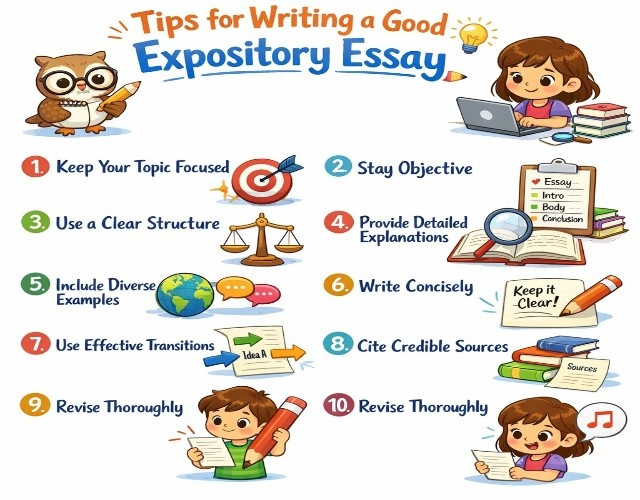
These practical tips will help you write clear, effective expository essays that engage readers and communicate information successfully.
1. Keep Your Topic Focused
Narrow your topic to something you can explore effectively within your assignment length. Topics that are too broad lead to superficial coverage that doesn't satisfy readers or meet assignment requirements.
2. Stay Objective
Present facts rather than personal opinions. Avoid bias and emotional language that might suggest you're trying to persuade readers. Let the evidence speak for itself without injecting your personal feelings.
3. Use a Clear Structure
Follow logical organization with each paragraph serving a specific purpose. Readers should be able to follow your train of thought easily from the introduction through the conclusion.
4. Provide Detailed Explanations
Don't just state facts, explain their significance and connections. Help readers understand why information matters and how evidence relates to your main points.
5. Include Diverse Examples
Use varied supporting evidence:
- Statistics, expert quotes
- Case studies
- Concrete examples.
Real world applications help readers connect abstract concepts to practical situations.
6. Write Concisely
Use clear, straightforward language that gets to the point efficiently. Avoid unnecessary complexity or wordy phrases that obscure your meaning. Every sentence should serve a purpose.
7. Use Effective Transitions
Connect paragraphs and ideas smoothly to guide readers through your logic. Words like "however," "for example," and "therefore" signal relationships between ideas.
8. Cite Credible Sources
Use reputable, reliable information from academic journals, .edu websites, and expert authors. Always cite sources properly to give credit and allow readers to verify information. Poor sources undermine your credibility.
9. Revise Thoroughly
Don't skip the editing phase; revision is where good essays become great. Check for clarity, coherence, and correctness. Multiple drafts improve your final product significantly.
10. Read It Aloud
Reading your essay aloud helps you catch awkward phrasing, confusing sections, and sentences that don't flow well. If something sounds odd when spoken, it needs revision.
Common Mistakes to Avoid in an Expository Essay
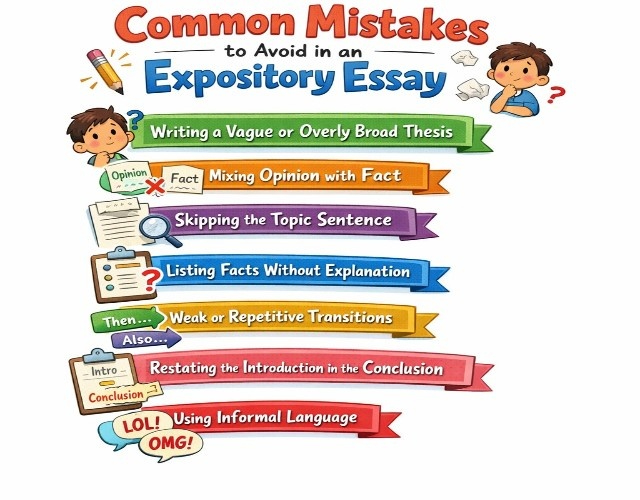
Even with a solid understanding of expository writing, students often make avoidable errors that hurt their grades. Here are the most common mistakes and how to fix them:
1. Writing a Vague or Overly Broad Thesis
Your thesis should do more than state a topic; it needs to preview exactly what the essay will explain.
A statement like "Climate change is a big problem" gives the reader nothing to follow.
Narrow it down and name the specific points your body paragraphs will cover.
2. Mixing Opinion with Fact
Expository essays inform, they don't persuade. Phrases like "I think," "In my opinion," or "You should" signal a shift into argumentative writing. Stick to factual, objective language throughout every section.
3. Skipping the Topic Sentence
As outlined in the body paragraph structure above, every paragraph needs an opening topic sentence. Jumping straight into evidence without one leaves the reader unsure what point is being made.
4. Listing Facts Without Explanation
Presenting a statistic or example and moving on is one of the most common content mistakes. Every piece of evidence needs a follow-up that explains how it connects to your thesis.
| Ask yourself: "So what does this mean?" |
5. Weak or Repetitive Transitions
Transitions do more than signal a new paragraph; they show the logical relationship between ideas.
Overusing "Also" or "Additionally" every time creates a choppy, list-like feel. Vary your transitions based on whether you're contrasting, illustrating, or sequencing ideas.
6. Restating the Introduction in the Conclusion
The conclusion section of this guide explains it clearly: your closing paragraph should synthesize, not repeat. Avoid copying your thesis word for word and instead reflect on what the explanation means in a broader context.
7. Using Informal Language
Contractions, slang, and casual phrasing undermine credibility. Maintain a consistent, formal tone from the introduction through to the final sentence.
Conclusion
Expository essays focus on informing and explaining rather than persuading. Understanding the different expository essay types helps you choose the right approach.
Following a clear structure with a strong introduction, well developed body paragraphs, and a concise conclusion ensures effective communication. The step by step writing process helps you create polished essays.
With this guide's tips and examples, you have the tools needed for success. Practice improves your skills, so keep writing.
Need extra support? Our professional essay writing service connects you with skilled writers who can help you succeed.
Get Professional Help With Your Expository Essay
Our expert essay writing service helps you create clear, well structured, and high-quality academic essays.
- Essays crafted by subject matter experts
- Guaranteed originality with plagiarism reports
- Delivered on time, every time
- Unlimited revisions for complete satisfaction
Achieve better results with expert support tailored to your academic needs.
Order Now