Understanding a Reflective Essay Outline?
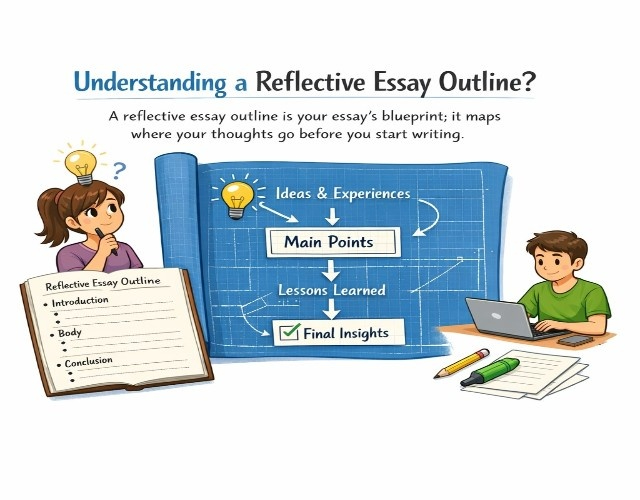
Unlike other essay types, where you're analyzing a text or building an argument from outside sources, a reflective essay draws on your own experience. That's actually why outlining matters even more here: without a structure, it's easy to wander into diary-style writing when your professor is expecting something more organized and analytical.
The outline keeps you focused. It reminds you that reflection isn't just about describing what happened, it's about analyzing what it meant and what you learned. Think of it as the scaffolding you build before the real writing starts. You can always adjust it as you go, but starting with a solid outline means you won't hit a wall mid-essay wondering where your third body paragraph is supposed to go.
For a deeper look at the full writing process from start to finish, see our guide on how to write a reflective essay.
The Basic Structure of a Reflective Essay Outline
Every body paragraph in a reflective essay has a job: describe, analyze, then evaluate. That three-part rhythm is what separates a reflective essay from a personal narrative. Here's how each section works:
IntroductionYour intro does three things: it hooks the reader, sets up the experience you're reflecting on, and closes with a thesis statement. The hook can be a question, a specific sensory detail from the experience, or an observation that draws the reader in. The thesis isn't an argument like you'd write for a persuasive essay; it's a statement of what you're reflecting on and why it was significant. Something like: "My first clinical placement shifted how I think about patient communication in ways I didn't expect." Body Paragraph 1: DescriptionThis paragraph answers: What happened? You're painting the scene, who was involved, what took place, and the specific details of the experience. Keep this grounded and concrete. You're not analyzing yet; you're giving the reader enough context to understand what you're reflecting on. If it helps, think of this as the "setting the stage" paragraph. Body Paragraph 2: Feelings and AnalysisHere's where you shift from describing to interpreting. What were your immediate reactions? How did you feel during and after the experience? What surprised you, confused you, or challenged your assumptions? This is where the essay starts to feel genuinely reflective; you're connecting the experience to your internal response and starting to ask why it affected you the way it did. Body Paragraph 3: Evaluation and LearningThis paragraph answers the biggest question of all: What did you take away from this? What did you learn about yourself, your field, and your assumptions? How has this experience changed how you'll approach similar situations going forward? This is where reflection becomes growth, and it's usually what professors are really looking for when they assign this type of essay. ConclusionYour conclusion ties everything together. Restate your thesis (in different words), summarize the key insight from each body paragraph, and end with a note about how this experience connects to your future, your goals, your professional development, or your personal growth. |
Reflective Essay Outline Template (Ready to Use)
The best reflective essay outlines are specific enough that you could hand them to someone else and they'd know exactly what to write. Here's a clean template you can copy and fill in, followed by a filled in version using a nursing placement as the example topic.
The TemplateI. Introduction
II. Body Paragraph 1: Description
III. Body Paragraph 2: Feelings and Analysis
IV. Body Paragraph 3: Evaluation and Learning
V. Conclusion
|
Filled-In Example (Nursing Placement Topic)
I. Introduction
II. Body Paragraph 1: Description
III. Body Paragraph 2: Feelings and Analysis
IV. Body Paragraph 3: Evaluation and Learning
V. Conclusion
|
Once you've built your outline, reading full reflective essay examples can show you how outlines like this translate into finished essays.
Free Downloadable Resources for Reflective Essay Outline
Types of Reflective Essay Outlines
If your professor assigned a specific model, such as Gibbs or Driscoll, your outline will follow that model's stages rather than the standard 3 paragraph format. Here's a quick breakdown of the main outline types:
1. Event Based Outline (Most Common)
This is the standard structure you've seen above: reflection on a specific experience or event. It works for most general assignments: placements, projects, significant moments, and challenges overcome. The structure follows description, feelings, and evaluation.
2. Personal Growth Outline
This type is used when your essay reflects on how you've changed over a longer period, rather than a single event. It's common in personal statements and university portfolio assessments. The structure shifts slightly: you open with where you were, trace the experiences that changed you, and close with where you are now and what that means going forward.
3. Model Based Outline
Some assignments, especially in nursing, social work, education, and healthcare, require you to follow a specific reflective framework. The most common ones are:
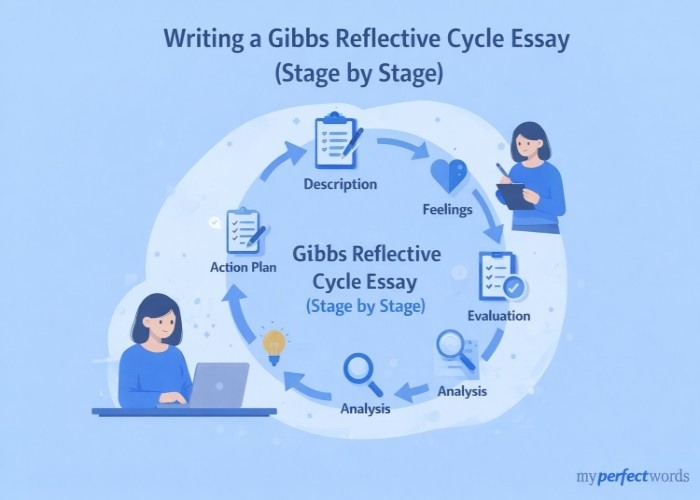
- Gibbs Reflective Cycle (6 stages: Description, Feelings, Evaluation, Analysis, Conclusion, Action Plan), your outline follows these six stages as sections
- Driscoll's Model (What? So What? Now What?), simpler three-stage structure
- Kolb's Experiential Learning Cycle (Concrete Experience, Reflective Observation, Abstract Conceptualization, and Active Experimentation), often used in professional training contexts
If your assignment requires the Gibbs model specifically, see our full Gibbs Reflective Cycle essay guide for a complete breakdown of each stage.
Nursing students, in particular, often use subject-specific structures; our nursing reflective essay guide covers them in detail.
No Time to Write Your Reflective Essay Yourself?
Our writers have mastered the outline, structure, and reflective tone to perfection.
50,000+ students have trusted us with their essays.
Reflective Essay Format: APA, MLA, and Chicago
For most reflective essays, the difference between APA and MLA comes down to whether you need a title page (APA does, MLA usually doesn't) and how you cite sources. Here's what you need to know for each format.
APA Format
APA format is most common in social sciences, nursing, education, and psychology. Follow these specs:
- Font: Times New Roman, 12pt
- Spacing: Double-spaced throughout
- Margins: 1 inch on all sides
- Title page: Required, include title, your name, institution name, course, instructor name, and date, all centered
- Header: Running head (shortened title in all caps) in top-left corner; page numbers top-right
- Abstract: Sometimes required, check with your professor; it's a brief 150 to 250 word summary of the essay
- References page: Include if you cite any external sources; APA format with hanging indent
MLA Format
MLA is most common in the humanities, English, literature, history, communications.
- Font: Times New Roman, 12pt
- Spacing: Double-spaced throughout
- Margins: 1 inch on all sides
- Header block: Top-left, four lines, your name, course name, professor name, date (day Month year format)
- Title: Centered, no bold or italics, just the title as regular text
- No title page typically (unless your professor requests one)
- Page numbers: Top-right corner, preceded by your last name
- Works Cited page: Required if you reference any sources; MLA format with hanging indent
Chicago Format
Chicago style is less common for reflective essays, but some professors in history and the arts require it.
- Same font, spacing, and margin specs as APA and MLA
- Footnotes or endnotes instead of in-text citations
- Bibliography page at the end
- No running head; page numbers centered at bottom or top-right
Quick Comparison
| APA | MLA | Chicago | |
|---|---|---|---|
| Title page | Required | Usually not required | Required |
| In-text citation | (Author, Year) | (Author Page) | Footnotes |
| Reference list | References | Works Cited | Bibliography |
| Running head | Yes | No | No |
| Common fields | Social sciences, nursing, and education | Humanities, English | History, arts |
Tips for Writing a Strong Reflective Essay Outline
A good outline catches the gaps before writing does; if a section feels thin in outline form, it'll be even thinner in the essay. Here are a few tips to get more out of the outlining process:
1. Start with your thesis.
Before you fill in anything else, write one or two sentences that name the experience and state what you learned from it. Everything else in the outline should connect back to this. If you can't write the thesis yet, that's usually a sign you haven't identified your central insight, worth sorting out before you build the whole outline around it.
2. Write in point form, not full sentences.
Your outline is a thinking tool, not a draft. Use short phrases and bullet points. The goal is to map out your ideas, not to write the essay twice.
3. Check that you have both description AND reflection.
Look at your body paragraphs. Does paragraph 1 describe what happened? Do paragraphs 2 and 3 actually reflect, analyze, and evaluate? A common mistake is spending too much space on description and not enough on the reflection itself; your professor can tell.
4. Check format requirements early.
If your professor specified APA or MLA, confirm before you start whether you need a title page and whether you're expected to cite any sources. Sorting this out at the outline stage saves you from reformatting a finished essay. For a walkthrough of what a personal reflective essay looks like, see our personal reflective essay guide.
5. If a section is empty in your outline, fix it now.
Empty outline sections become thin essay paragraphs. If you can't fill in at least three to four bullet points for a body section, you either need to think more deeply about that part of your experience, or restructure so you're giving more space to the sections you actually have things to say about.
Final Thought